
BELLINGHAM · LIVING HERE
Galbraith Mountain.
The 70-mile backyard.
The mountain-bike trail network inside Bellingham city limits — and why it changes how people choose where to live here.
Galbraith Mountain · Bellingham, Washington
Most cities have a park you drive to on weekends. Bellingham has a whole mountain you can pedal to from a coffee shop downtown. Galbraith Mountain is 70-plus miles of singletrack spread across roughly 3,000 acres on the southeast edge of town, and after eleven years selling real estate here I can tell you it does something to the housing map that surprises people: buyers literally pick neighborhoods by how fast they can get to the trailhead. Here’s the honest rundown — what Galbraith actually is, how to ride or walk it, and how it factors into where you’d want to live.
What Galbraith actually is
Galbraith is a working forest and a recreation area at the same time. The land is privately owned by Galbraith Tree Farm, LLC — it’s still an active tree farm — but the trails on it are open to the public, built and maintained almost entirely by volunteers through the Whatcom Mountain Bike Coalition (WMBC), who’ve been stewarding the mountain for over 30 years.
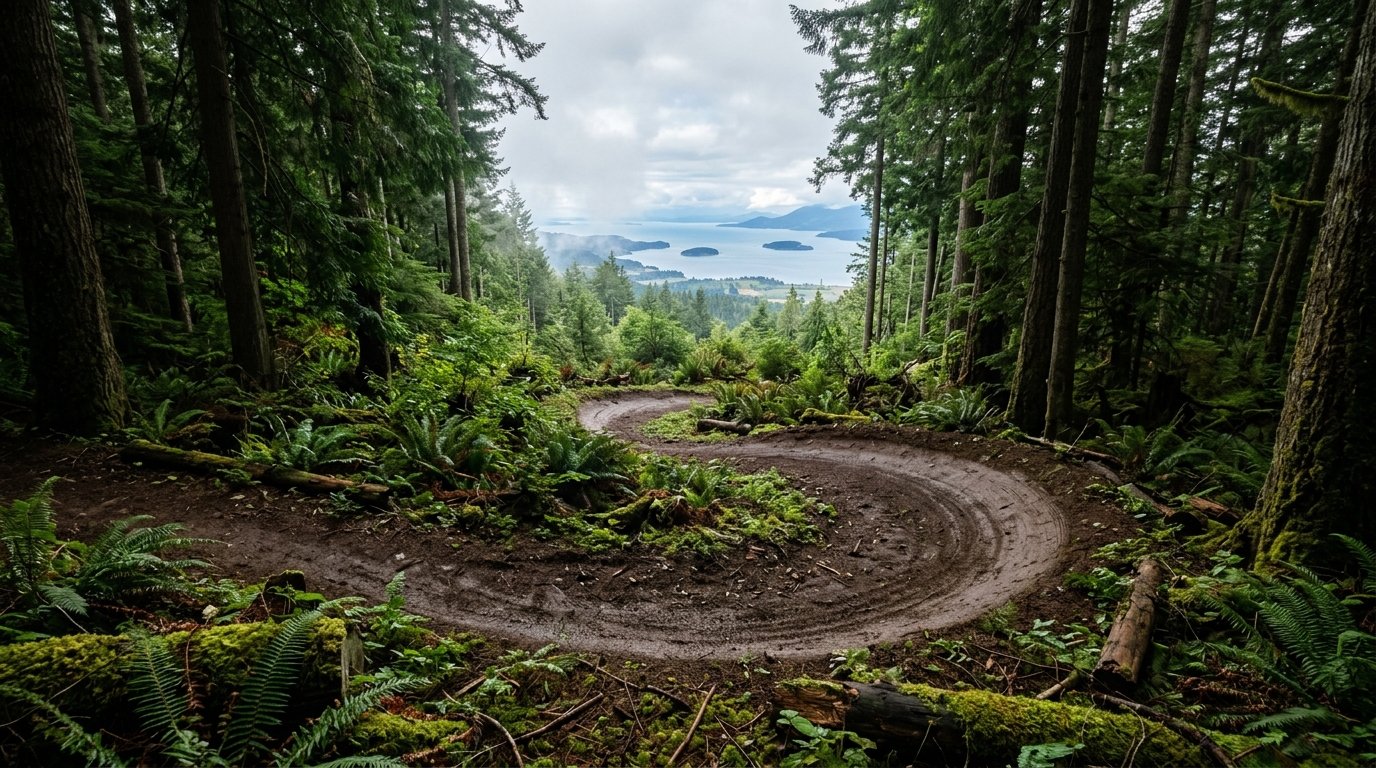
It’s primarily a mountain-bike mecca — one of the best-known trail networks in the Pacific Northwest — but it’s also open to hikers, trail runners, and dog walkers. The trails climb from town up to viewpoints that look out over Bellingham Bay, the San Juan Islands, and on a clear day, Lummi Island and the Canadian coast range. You can be in the trees, climbing switchbacks, ten minutes after leaving your driveway.
Why it’s not going anywhere
This is the part I make sure buyers understand, because it’s the difference between a nice amenity and a permanent one. In 2018 the City of Bellingham secured conservation easements covering about 2,182 acres of the privately-owned land, which adjoin roughly 4,250 acres of public land managed by Whatcom County. In plain terms: public recreation access to Galbraith is guaranteed in perpetuity. The tree farm can keep logging, but the trails can’t be closed off and the mountain can’t be sold out from under the riders.
From a real-estate standpoint, that permanence is what makes “trail access” a real, durable feature of a Bellingham home rather than a someday-maybe. It’s protected the same way a park is.
Where you actually get on the mountain
There are three main ways onto the network, and which one is closest to you genuinely shapes the daily experience:
- North side — Birch Street trailhead. The classic in-town access off Lakeway Drive, close to downtown and Whatcom Falls Park. Parking here is small (about eight cars), so locals often pedal in from home or park at Whatcom Falls and ride over rather than crowd the residential street.
- South side — the Samish/Galbraith Lane lot. A newer, much larger lot (close to 200 stalls, with restrooms and even horse-trailer parking) across from Galbraith Lane on Samish Way. This is the easy-arrival option if you’re driving with a bike and a friend.
- Lake Padden. You can also link in from the Lake Padden side on the south end, which pairs a lake loop with the lower mountain trails.
The network is well-mapped on Trailforks, and the WMBC site is the source of truth for current trail status and the directional/seasonal rules. If you’re brand new, the south-side trails tend to be the friendlier on-ramp.
For mountain bikers
Galbraith earns its reputation. The network runs the full range — mellow flowy blue trails, machine-built berms and jump lines, and steep, rooty, technical black-diamond descents that riders travel a long way to session. Most of the climbing is on shared fire roads and dedicated up-trails, with the fun saved for the way down. It rides nearly year-round; this is the PNW, so winter means mud and a willingness to wash your bike, but the dirt is famously good.
E-bikes: as of February 2024, the City officially allows Class 1 e-mountain-bikes (pedal-assist, capped at 20 mph) on the network — they’d quietly become common already, and the same vote cleared the way for the trail system to keep expanding (toward roughly 85 miles). If you’ve been holding off on an e-bike because you weren’t sure it was allowed, it is now.
Not just for bikes
You don’t have to own a mountain bike to get value out of living near Galbraith. Plenty of my clients use it as a trail-running network, a dog-walking spot, or a place to hike to a viewpoint on a Sunday morning. The one etiquette thing worth knowing: it’s a bike-primary mountain with a lot of fast, blind, sometimes one-directional descents, so on foot you stay alert, keep dogs close, and step aside for downhill riders. Treated that way, it’s a fantastic walking forest most hours of the day.
How Galbraith shapes where people buy
Here’s where it touches my world. For a meaningful slice of Bellingham buyers — and not just the spandex crowd — proximity to a Galbraith trailhead is an actual line on the wish list, right next to schools and commute. A few patterns I see:
- Silver Beach, Whatcom Falls, and the Lakeway/Birch corridor on the north side put you closest to the in-town Birch Street access — you can ride from the house. These tend to draw the “I want to pedal to the trail” buyers.
- Samish, South Hill, and the south-end neighborhoods sit near the big new Samish Way lot and the Lake Padden links — easy access without fighting the small north lot.
- Edgemoor and Fairhaven trade direct trail proximity for walkability and bay character, but they’re still a short drive — buyers who want both downtown life and Galbraith weekends land here.
None of this means you should overpay to be next to a trailhead. But if riding or trail-running is part of why you’re moving to Bellingham, I’d factor access in early — it narrows the map fast, and it’s one of those amenities that holds its value because, again, it’s protected for good.
Frequently asked
Is Galbraith Mountain free to ride?
Yes — there’s no entry fee or day-use pass to ride or hike Galbraith. The trails are maintained by volunteers through the WMBC; if you ride it regularly, a WMBC membership or donation is the right way to give back, since the network exists because of that work.
Do I need a mountain bike, or can I hike it?
You can hike, trail-run, and dog-walk it too. It’s bike-primary with fast directional descents, so stay alert and yield to downhill riders, but it’s a great walking forest.
Are e-bikes allowed on Galbraith?
Yes. As of February 2024 the City of Bellingham officially allows Class 1 pedal-assist e-mountain-bikes (20 mph assist cap) on the network.
Where should I park?
Three options: the small Birch Street lot on the north side (often full — many locals pedal in or park at Whatcom Falls), the large ~200-stall lot across from Galbraith Lane on Samish Way (south side, with restrooms), or the Lake Padden area on the south end.
Will the trails always be there?
Effectively yes. The 2018 city easements guarantee public recreation access in perpetuity across the easement acreage, adjoining county-managed public land — so access is permanently protected even though the land is a privately owned tree farm.
Which Bellingham neighborhoods are closest?
North-side neighborhoods like Silver Beach, Whatcom Falls, and the Lakeway/Birch corridor are closest to the in-town Birch Street access; Samish and the south-end neighborhoods are near the larger Samish Way lot and the Lake Padden links.
Want to live within pedaling distance?
If trail access is part of why you’re looking at Bellingham, tell me how you ride and I’ll narrow the neighborhoods with you. No pressure, no script.
Genaro Shaffer · Licensed WA Real Estate Broker #27119 · Bellwether Real Estate · Member NWMLS · Equal Housing Opportunity