

Bellingham · what is underground
The coal beneath Bellingham
For a century this city ran on coal — dug from seams that still riddle the ground under downtown, under Birchwood, and along the south shore of Lake Whatcom. Here is what was mined, where it went, and what is still down there.
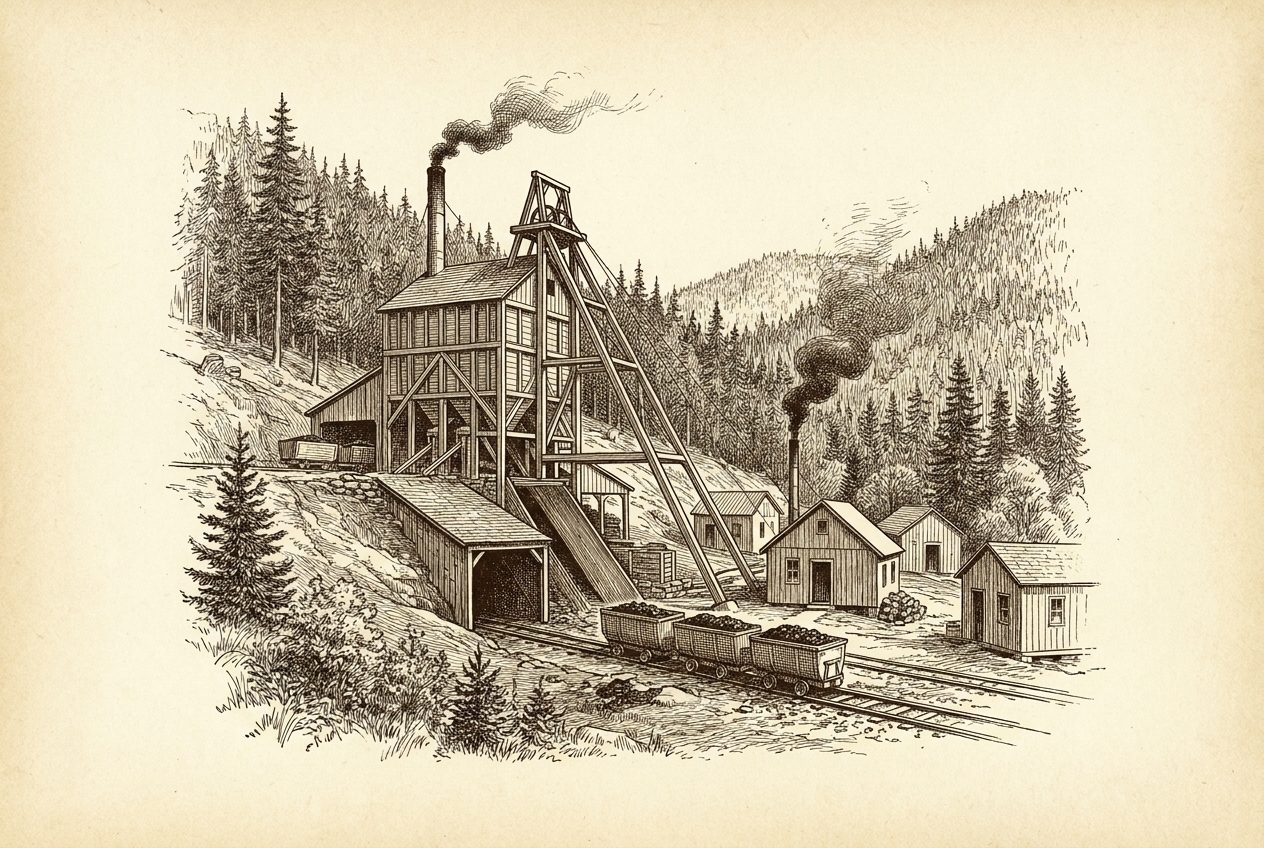
Coal was Bellingham’s first big industry, and for years its biggest. Long before the railroads and the salmon canneries, it was the promise of coal under Bellingham Bay that drew the first companies north. Four mines, in particular, shaped the city — and left tunnels beneath neighborhoods where people now live, shop, and walk the trails.
The first dig
The very first coal claim on the bay belonged to Captain William Pattle, a Hudson’s Bay Company man who found coal near Fairhaven in 1851. His mine was short-lived, but it put Bellingham Bay on the map as coal country and set off everything that followed.
The mine that named a neighborhood
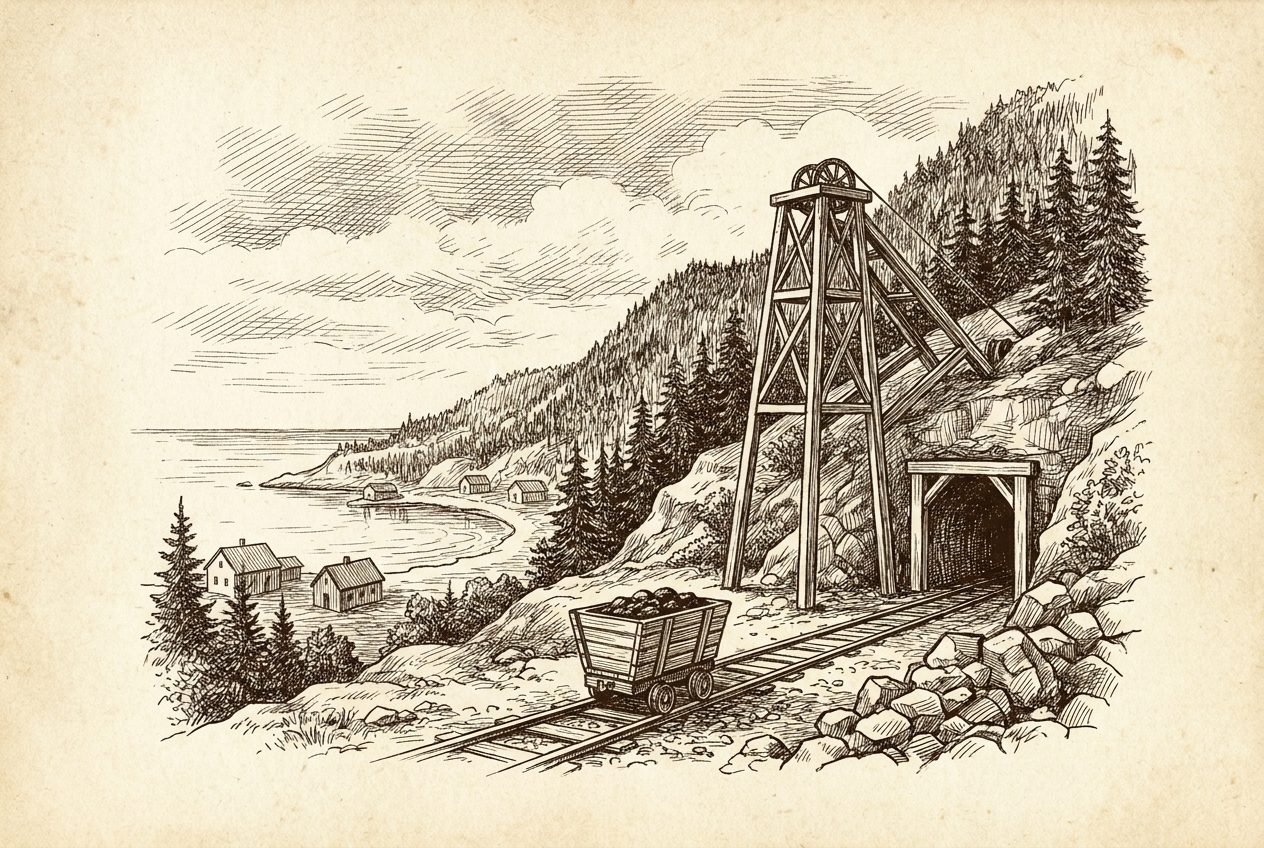
In 1853 Henry Roeder found a seam of coal seventeen feet thick on his land. He dug out sixty tons, shipped it to San Francisco at sixteen dollars a ton, and sold the tract to the California-based Bellingham Bay Coal Company. In 1854 the company’s manager, Edmund Fitzhugh, named the new Sehome Mine for his father-in-law, Sea-hom, a Klallam-born leader of a Samish village — and the name stuck to the neighborhood that grew up over it.
The mine opened near present-day Laurel Street in 1855 and ran for more than two decades, its shafts reaching as deep as 1,200 feet. By 1860 it had produced some $300,000 and employed over a hundred men, making it for a time the largest single employer in Washington Territory. A full company town grew around it — a store, boarding houses, saloons, miners’ cottages. But the work was brutal: tunnel collapses, underground fires, and flooding dogged the mine until the company finally closed it in 1878. Most of its original maps were lost a generation later, in the 1906 San Francisco earthquake and fire.
The mine under Birchwood
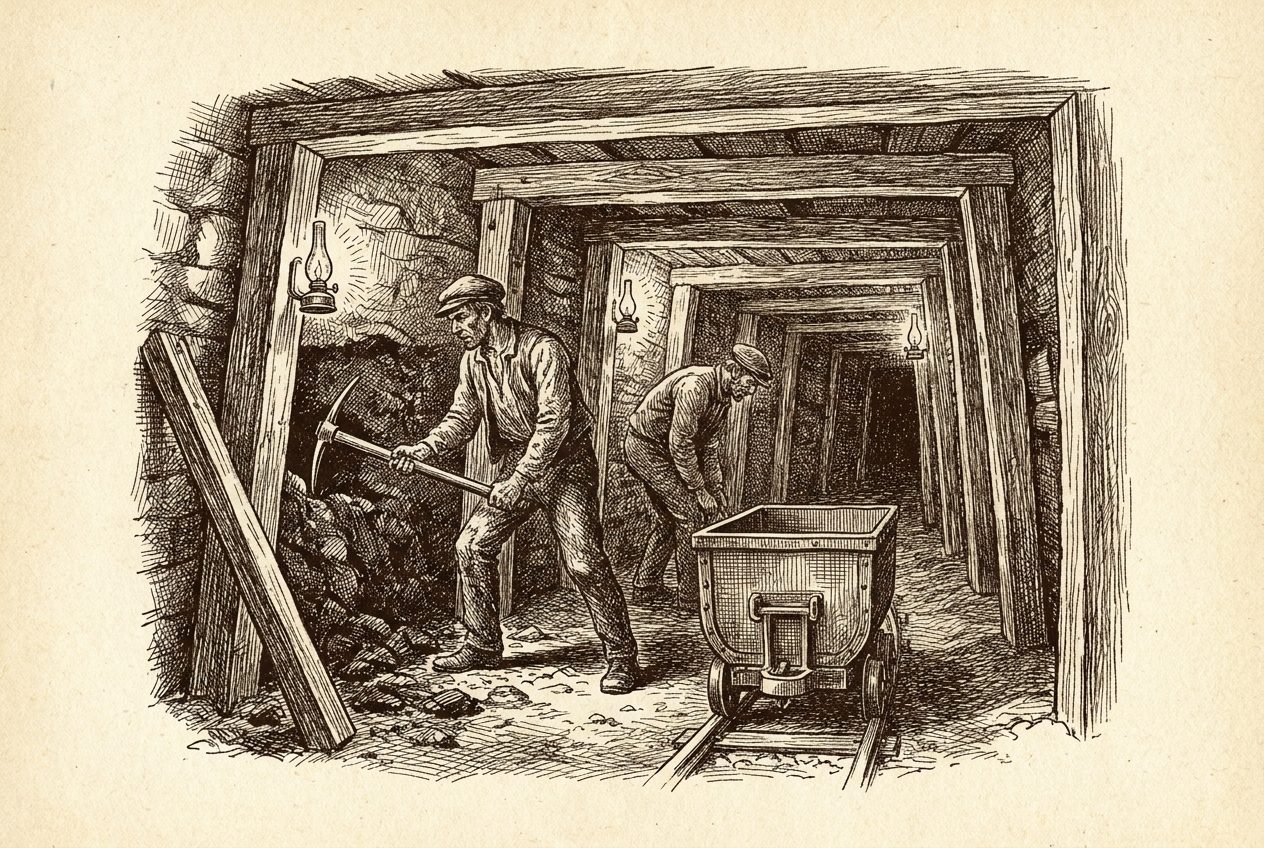
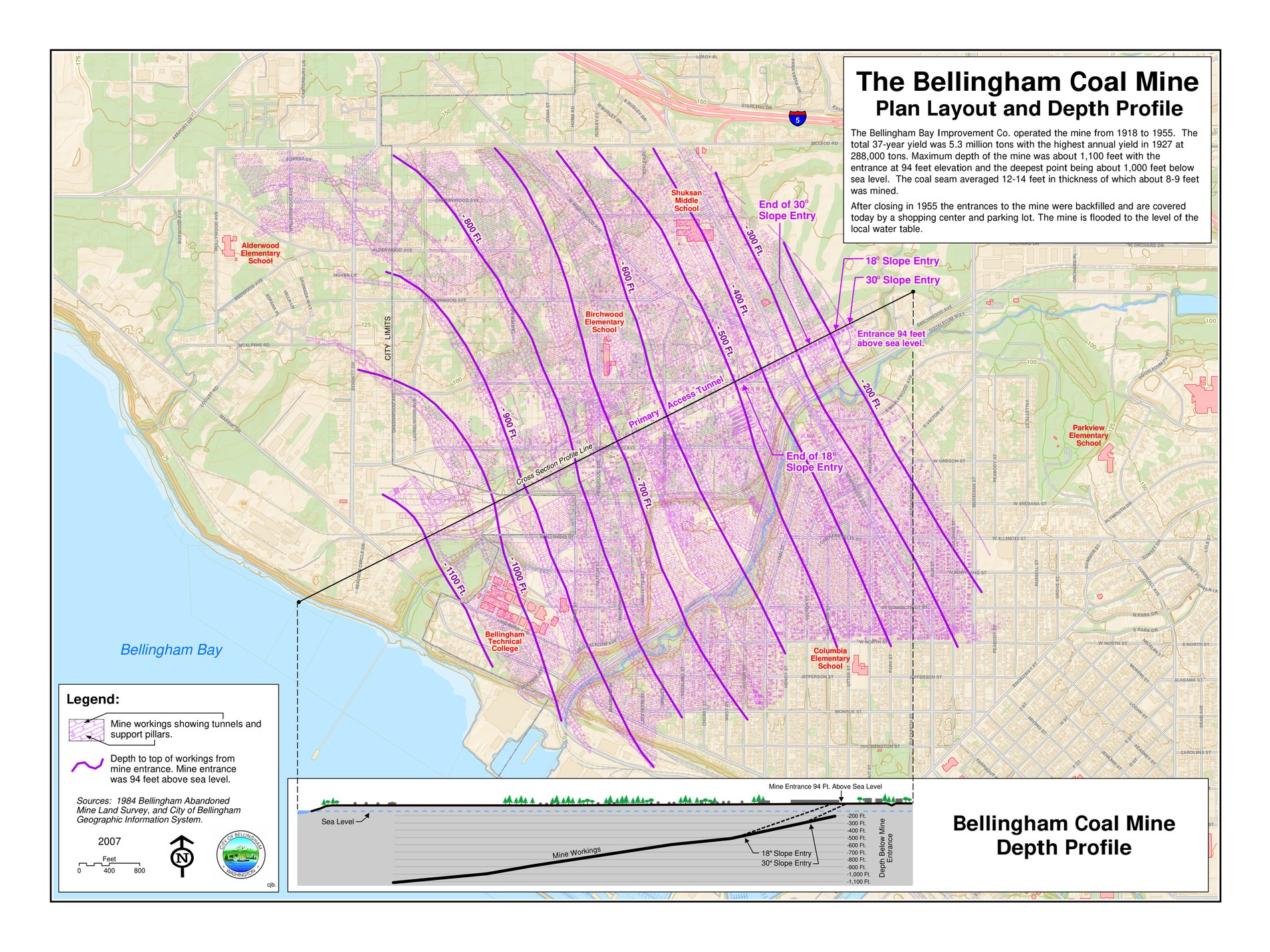
Bellingham’s longest-running mine was not downtown at all — it was under what is now the Birchwood neighborhood. From 1918 to 1955 the Bellingham Bay Improvement Company worked the Bellingham Coal Mine here, sending crews down a sloping entrance through eleven levels of tunnels that spread beneath nearly the whole neighborhood and reached about 1,100 feet down. The coal seam ran twelve to fourteen feet thick, of which eight or nine feet was taken. Over thirty-seven years the mine produced roughly 5.3 million tons of coal — a peak of 288,000 tons in 1927 alone.
At its height around two hundred miners worked it, much of the operation directed by foreman Jim Pascoe. About a tenth of the coal heated local homes; the rest went east to Concrete, Washington, to fire the cement kilns.
When cheaper fuels took over in 1955 the mine closed, its entrances were backfilled, and the workings slowly flooded to the level of the water table, where they sit today. The sloping entrance is gone — paved over by the Park Manor Shopping Center, the block with the old Albertsons at 1650 Birchwood Avenue.
The deadliest day
On the south shore of Lake Whatcom, the Blue Canyon mine loaded coal onto rail and barge — some of it bound for the U.S. Pacific Fleet. On April 8, 1895, a methane explosion tore through the workings and killed twenty-three men, among the worst mine disasters in Washington’s history. A monument to the dead still stands in Bellingham’s Bayview Cemetery.
The four mines at a glance
Where they were
Four mines, spread from downtown out to the south shore of Lake Whatcom. Tap a marker for the story.
Gold marks the four mines; green marks the miners’ memorial at Bayview Cemetery. Locations are approximate.
What is still down there
More than a century on, the old workings still make themselves known. Downtown, where the Sehome mine ran, the pavement has occasionally given way — holes have opened over the years on Railroad Avenue, State Street, and Holly Street. When the Mason Building on Holly burned in 1994, test drilling in 1997 found shallow mine tunnels right beneath the block now filled with shops and offices. Most of the deeper tunnels, their timbers long rotted and their pumps abandoned, have collapsed and flooded — which, counterintuitively, is part of why dramatic cave-ins are so rare.
The sinkholes that actually happened
Ask around Birchwood and you will eventually hear the one about the house that got swallowed by a sinkhole. As far as the written record goes, it never happened — no documented sinkhole has ever taken a house in Birchwood, and the mine below the neighborhood is a big part of why: its tunnels run 300 to 1,100 feet down, far too deep to open a crater at the surface. But the legend did not come from nowhere. Bellingham has had real, documented cave-ins — they just happened over the shallow workings, downtown and at Lake Whatcom.
In Birchwood itself, the spots geologists actually watch are not the deep tunnels but the handful of old ventilation shafts — vertical bores that were sealed decades ago and, in a few second-hand accounts, have slumped into shallow depressions in yards. The 1984 engineering review flagged only the ground near the old mine entrance off Northwest Drive, where the workings come closest to the surface. So if a neighbor swears their backyard dips because of the mine, a settled vent shaft is the one version of the story that might be true.
Is there coal under your house?
Quite possibly — especially in Birchwood. The City of Bellingham keeps a historic coal-mine map showing exactly where the Bellingham Coal Mine’s tunnels run beneath the neighborhood. A 1984 engineering study found the cave-in risk low almost everywhere, because the tunnels sit hundreds of feet down and have largely collapsed; the only shallower, more closely watched stretches are near the old entrance off Northwest Drive. If you want to know whether your lot sits over a tunnel, the City’s map is the place to look.
City of Bellingham coal-mine mapCommon questions
Is there really coal under Bellingham?
Yes. Bellingham grew up on coal seams that were mined for roughly a century, and old tunnels still lie beneath downtown, beneath the Birchwood neighborhood, and along the south shore of Lake Whatcom.
Where was the Sehome coal mine?
Under today’s downtown Bellingham, opening near Laurel Street. It operated from 1853 to 1878, reached depths of around 1,200 feet, and gave the Sehome neighborhood its name.
Is my Birchwood house going to sink into a mine?
Almost certainly not — and despite the neighborhood legend, no house in Birchwood has ever been lost to a sinkhole in the documented record. The Bellingham Coal Mine’s tunnels under Birchwood are 300 to 1,100 feet down and have mostly collapsed and flooded over the decades. A 1984 study found the cave-in risk low except for a few shallow spots near the old entrance off Northwest Drive. The City of Bellingham’s coal-mine map shows where the tunnels run beneath each part of the neighborhood.
Where did all the coal actually go?
Sehome coal fueled San Francisco-bound steamships; Blue Canyon coal helped supply the U.S. Pacific Fleet; and the Birchwood mine sent about ninety percent of its coal east to Concrete, Washington, to fire the cement kilns.
Sources: HistoryLink.org, WhatcomTalk (“Bellingham’s Ore Lore”), the City of Bellingham, Bellingham Alive, and Western Washington University Heritage Resources. The Lummi Nation and Nooksack Tribe are the original peoples of this land.
Back to the Bellingham timeline