

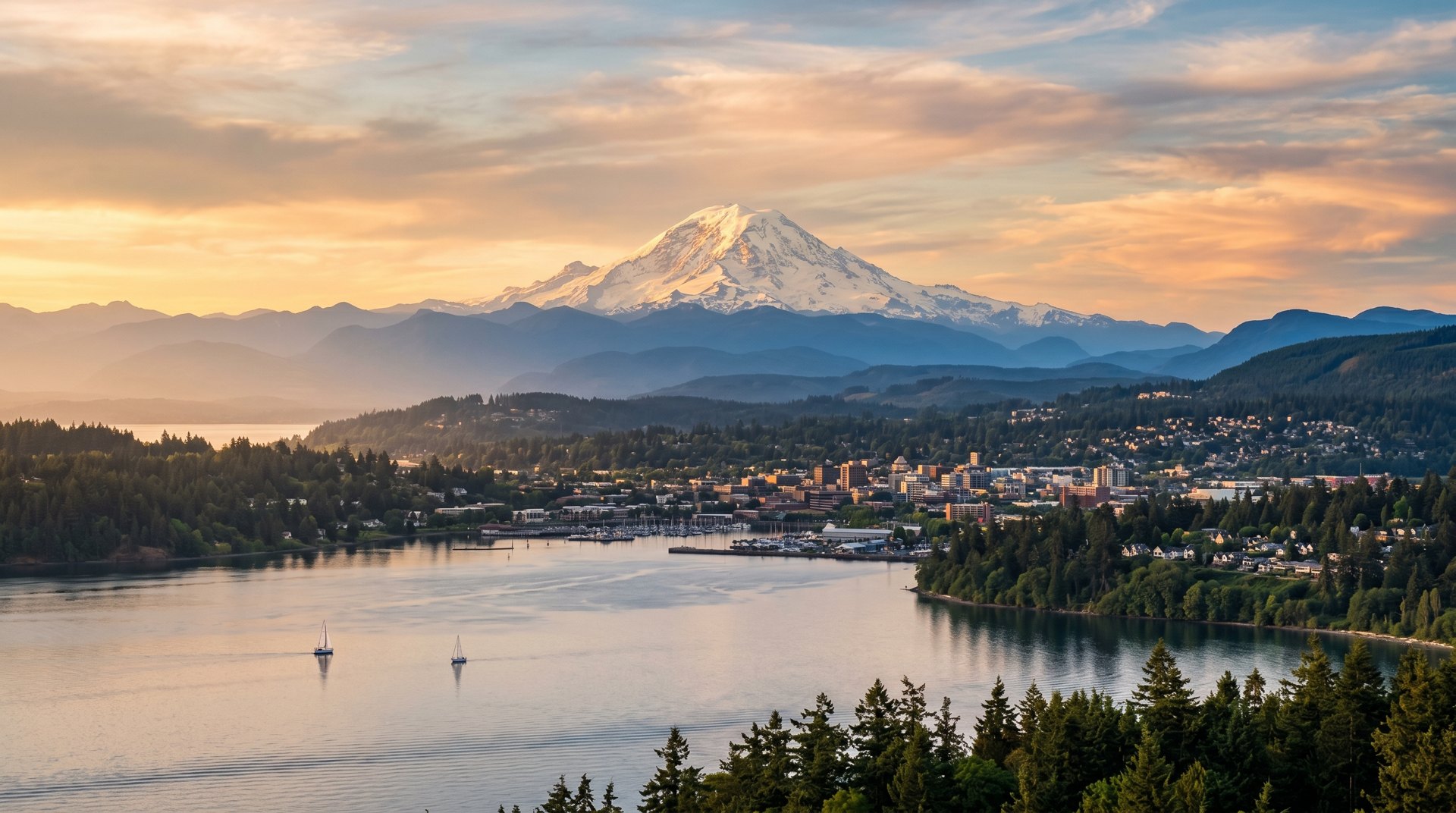
PORTLAND → BELLINGHAM · RELOCATION GUIDE
From Portland to Bellingham.
The honest math.
Oregon’s income tax is 9.9%. Washington’s is zero. Here’s what the full swap actually costs you.
The Portland-to-Bellingham call I get almost every week follows a pattern: someone’s done the income-tax math, maybe run the numbers on a back-of-napkin spreadsheet, and they want to know if it actually pencils. They already love the Pacific Northwest — they just want to know whether trading a 2.5-million-person metro for a 98,000-person bay-front city makes financial and lifestyle sense. After 11 years selling homes in Whatcom County, my honest answer is: it depends on your income, your spending habits, and what you actually want your daily life to look like. Let me give you the real picture.
The equity reset, in actual numbers

Portland’s median single-family home sold for roughly $512,000–$525,000 in early 2026, down slightly from a peak around $575,000 in 2024. Bellingham’s median is approximately $710,000 as of early 2026 (Redfin data; Cascadia Daily News reported a 2025 annual median of $755,000 for all residential types). The short version: Bellingham is more expensive per square foot, and that surprises a lot of Portland buyers who expect to “trade up” the way a California buyer might.
The financial case for this move is not an equity arbitrage play. It is a tax play.
| Portland, OR | Bellingham, WA | What changes | |
|---|---|---|---|
| Median single-family price | ~$512K (Redfin Apr 2026) | ~$710K (Redfin Apr 2026) | +$138K purchase price |
| Property tax (effective rate) | ~1.06% (Multnomah Co.) | ~0.85% (Whatcom Co.) | Slightly lower in Bellingham |
| Property tax on median home | ~$5,430/yr | ~$5,525/yr | Roughly flat |
| State income tax | 4.75%–9.9% (graduated) | 0% | Big annual savings |
| Sales tax | 0% | 9.1% (as of Jan 2026) | New ongoing cost |
| Gas (regular, ~2025 avg) | ~$3.87/gal | ~$4.20/gal | Slightly higher in WA |
| Groceries index | ~7% above national avg | ~4–5% above national avg | Roughly similar |
| Utilities (avg monthly) | ~$180–$250/mo | ~$160–$220/mo | Slightly lower in Bellingham |
The income tax math for a Portland household earning $200,000/year:
Oregon taxes that income at graduated rates topping out at 9.9% above $250K (single) / $250K (married). For a $200K household, Oregon state income tax runs roughly $17,000–$18,000 per year. Washington charges zero.
But add back the sales tax: A household spending $60,000 per year on taxable goods in Washington owes roughly $5,460 in sales tax that would have cost them nothing in Oregon. Net annual advantage of moving to Washington: roughly $12,000–$13,000 for a $200K-income household — before any investment compounding.
At $100,000 household income, Oregon state tax runs approximately $7,500–$8,000. Sales tax on $50,000 of taxable spending in WA: ~$4,550. Net annual savings: roughly $3,000–$3,500.
The break-even point is somewhere around $60,000–$75,000 in household income. Below that, the sales tax burden can actually offset or exceed the income tax savings. Above it, Washington wins meaningfully. And above $300,000, Washington wins by a wide margin.
Worked equity example — Portland seller in the Beaverton market: Sell a $575,000 Beaverton home, net ~$540,000 after 6% selling costs. Buy a $650,000 Bellingham home with 20% down ($130,000), add ~$15,000 in closing costs: total cash needed $145,000 out of your $540,000 net. Left over: ~$395,000 — which you can put toward a larger Bellingham home, pay down the mortgage, or invest. That is a meaningful liquidity event, even if you are not “trading down” in price.
Cost of living, line by line
What gets cheaper in Bellingham:
Restaurants and casual dining. Portland’s food scene is genuinely excellent and expensive. Bellingham has good food — strong brewery and farm-to-table culture — but at lower price points. A sit-down dinner for two runs $60–$90 in Portland; comparable quality in Bellingham is $45–$70.
Utilities. Bellingham is served by Puget Sound Energy and the city’s own Bellingham Public Works. Average monthly utility bills run roughly $160–$220 for a typical single-family home, modestly below Portland’s $180–$250 average.
State income tax. Already covered above, but worth repeating as a line item: this is the single largest cost-of-living shift for any professional household.
What gets more expensive — or stays the same:
Housing. Bellingham is more expensive per square foot than comparable Portland neighborhoods. For the same $512,000 you sell your Portland home for, you are buying into a smaller Bellingham home or a less central neighborhood.
Sales tax. Oregon’s 0% sales tax is a real, tangible benefit you are giving up. Every car purchase, appliance, electronics buy, and furniture order gets 9.1% more expensive the moment you become a Washington resident. Plan accordingly — make large purchases before you move or during visits back to Oregon.
Gas. Washington fuel taxes are slightly higher. Budget roughly $0.30–$0.40 more per gallon than you are paying in Portland.
Groceries. Broadly similar — both cities run 4–7% above the national average. Portland has more competition among grocery chains; Bellingham has Fred Meyer, Haggen, Costco, and a Trader Joe’s.
Net assessment: For households earning above $100,000, Bellingham is cheaper on an after-tax basis despite the higher housing prices. For households near or below $75,000, the math is closer than the headline income-tax story suggests.
The climate — the honest part

I am not going to sell you on a weather upgrade here, because I would be lying to you.
Portland averages about 144 sunny days per year and 43 inches of rain annually. Bellingham averages roughly 2,000 sunshine hours per year versus Portland’s 2,340 — meaning Bellingham is actually cloudier. Both cities have similar annual rainfall around 36–43 inches, with the bulk falling October through April.
If you are leaving Portland for sunshine, stop and reconsider. The gray season in Bellingham runs from October to June, with occasional breaks. Those are not typos.
Where Bellingham wins on climate:
Portland summers have gotten dangerous. The 2021 heat dome hit Portland at 116°F — an event climate scientists classified as a statistical once-in-10,000-years occurrence, though warming trends make that label less reliable every year. Since 2021, Portland has recorded 16 days above 100°F, with heat events in 2022, 2023, and 2024 as well. The Willamette Valley sits in a geographic funnel that amplifies heat domes; Bellingham does not. Bellingham’s July average high is 72°F. Summer here is reliably mild. Most homes still don’t need air conditioning.
Portland also sits in a wildfire smoke corridor — the Columbia River Gorge, the Willamette Valley, and surrounding Oregon and Washington forests all contribute to air quality events that have become a near-annual summer fixture. Bellingham gets smoke too, primarily from BC wildfires, but less frequently and with better marine dispersion when the onshore flow kicks in.
The honest winter picture:
Bellingham gets roughly 9 inches of snow per year on average — more than Portland’s 3 inches, and it sticks longer because temperatures stay near freezing rather than swinging above it like Portland does. The hills in Bellingham can be genuinely slippery in December and January. Budget for winter tires if you are coming from Portland.
My honest advice: Come visit in November. Not in August when everything is gorgeous and the bay is glittering and you will say yes to anything. Come in November when it has been gray for six weeks and the novelty has worn off. If you still like it, you will be fine. Most people who do this visit come back ready to move. A few realize they need more sun and that is important to know before you sell your house.
Why people leave Portland
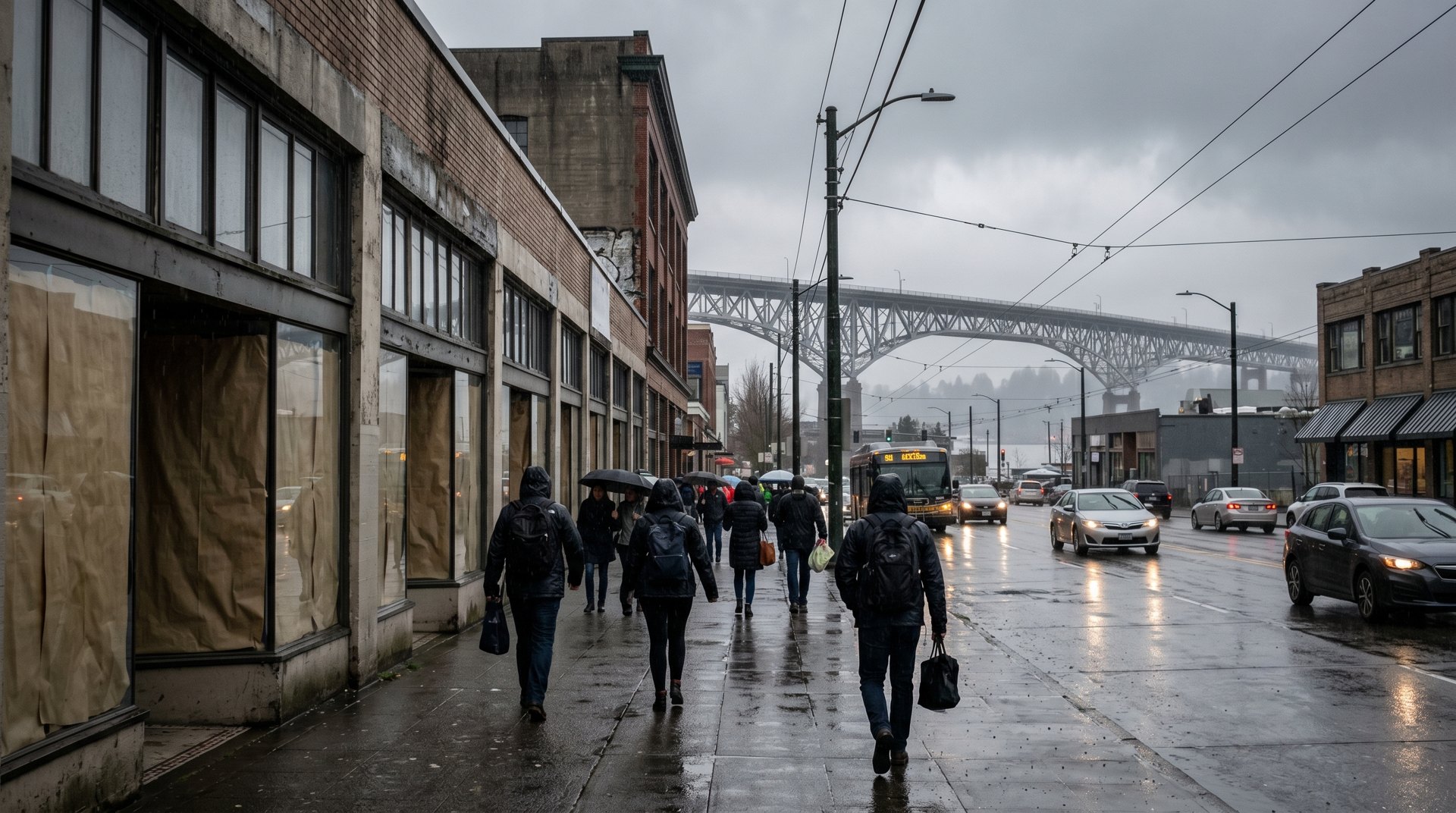
The Portland I moved to in the mid-2010s and the Portland of 2026 are different cities in ways that are hard to overstate.
The most visible push factor is the downtown. Portland’s once-celebrated urban core — the Pearl District, Old Town, the waterfront — went through a difficult stretch from 2020 onward. Property crime, open drug markets following Measure 110’s rollout (later revised in 2024), visible homelessness, and business closures created a feedback loop. As of early 2026, Multnomah County counts roughly 18,500 homeless residents — a 29% increase from early 2025, even as violent crime has dropped significantly (homicides fell 51% in the first half of 2025). The picture is complicated: things are genuinely improving in some metrics while others remain stubbornly bad. Portland buyers do not describe this to me as fear — they describe it as exhaustion. They are tired of the daily friction.
The second push factor is traffic. Portland’s metro congestion on I-5, I-84, and the Sunset Highway is among the worst in the Pacific Northwest. The Rose Quarter bottleneck on I-5 has been under political debate for years without resolution. Commutes from suburbs like Hillsboro or Lake Oswego into Portland can run 45–75 minutes each way.
The third is Oregon’s tax structure. Even Portland progressives — and many of my Portland clients self-identify that way — reach a point where paying 9.9% on their top income bracket stops feeling like civic participation and starts feeling like a calculation they should revisit. Especially when Seattle’s tech-and-remote economy has made Washington residency mainstream.
The fourth is schools. Portland Public Schools has had real volatility — budget cuts, school closures, redistricting conflicts. Families with kids in middle or high school often time the move around a school transition year.
Commute reality — can you still work?
Bellingham to Portland is 262 miles — roughly 4 hours and 20 minutes of non-stop driving on I-5. That is not a commutable distance under any interpretation.
If your job is in Portland and fully remote, this move is clean. If it is hybrid with a monthly or quarterly in-person requirement, it is manageable. If it requires you in Portland more than once a month, think carefully about the travel burden.
Air travel: Alaska Airlines added direct Portland PDX–Bellingham BLI service in March 2026 — the first time Bellingham has had direct service to Portland in years. Flight time is approximately one hour. This changes the calculus meaningfully for hybrid workers. A monthly Portland trip is now a 1-hour flight plus airport time rather than a 9-hour round-trip drive.
For everything else — New York, Chicago, major California cities — fly from Seattle-Tacoma International (SEA), 90 minutes south on I-5. BLI has limited routes (primarily Allegiant to California and Nevada, Alaska to Seattle and now Portland). PDX was likely your travel hub; SEA becomes your new one.
Remote work in Bellingham: The infrastructure is there. Fiber internet via Comcast and Ziply covers most of the city. WeWork-style coworking exists at a smaller scale. The remote-work community in Bellingham is substantial — Bellingham draws tech workers from Seattle who want smaller-city life, and Portland transplants fit right in.
Buying a home here without flying up six times

Most of my Portland buyers complete this process in one to two in-person trips total — sometimes just one.
Step 1: Discovery call. We spend 30 minutes on what you need (bedrooms, neighborhoods, commute tolerance, school district, must-haves). I set you up on NWMLS listing alerts — these are MLS-direct, not Zillow approximations.
Step 2: Virtual tours. For serious contenders, I do live FaceTime walkthroughs at your scheduled time. I open every drawer, walk the crawlspace, go in the garage. You ask questions in real time.
Step 3: The scouting trip. One or two days in Bellingham. I book you a concentrated schedule — 8 to 12 properties, neighborhood drives, school walkthroughs if relevant, a dinner or two to get a feel for the town. Most Portland buyers take the Amtrak Cascades up — a scenic 4.5-hour train ride that drops you at Bellingham Station downtown with no rental car needed initially.
Step 4: Offer and inspection. Washington uses a standard earnest money deposit (typically 1%–3%) with an inspection contingency as a normal part of offers here — unlike the waived-contingency environment of 2021–2022. You have the right to a full inspection. I typically coordinate a same-day inspector so your trip is one visit, not two.
Step 5: Closing. Washington closings are handled by escrow and title companies — I work primarily with Chicago Title’s Bellingham office. You can sign remotely via notary or mobile signing service. You do not need to be here in person for closing.
Coordinating with your Portland sale: The standard approach is to list Portland first, sell with a buyer’s possession date of 30–45 days out, then make your Bellingham offer with a close date that aligns. Bridge loans exist if you need to close on Bellingham before Portland closes, but most Portland sellers time it cleanly.
Schools — the comparison families ask about
Bellingham School District serves the city proper and has roughly 12,000 students. It has been more stable than Portland Public Schools over the last several years — no major closures, reasonably consistent funding. Sehome High School and Bellingham High School are the main high schools; both have solid academic programs and strong arts tracks. Whatcom Community College is a feeder into Western Washington University.
Western Washington University is based in Bellingham — a 16,000-student mid-sized university with a strong education, environmental science, and business college. Its presence shapes the culture of the city: it is walkable from downtown, it keeps the demographic young, and it supports a full university arts calendar.
Ferndale School District, 10 minutes north, is a popular choice for families who prefer slightly smaller schools with newer facilities — Ferndale has done significant capital construction over the last decade. Lynden School District, further north, has a strong academic reputation and a notably different cultural flavor (historically conservative, Dutch-Reformed community heritage).
If schools are the deciding factor in your specific neighborhood choice, I can walk you through the district boundaries in detail — they matter a lot in how I narrow the neighborhood search.
Five Bellingham neighborhoods Portland buyers tend to land in

Fairhaven. This is the first choice for most Portland transplants, and it is not hard to see why. Fairhaven is a walkable Victorian-era village district at the south end of Bellingham — restaurants, independent bookstore (Village Books, one of the best in the Pacific Northwest), wine bar, ferry terminal to the San Juan Islands, views over Bellingham Bay. The vibe is unmistakably Portland: independent, slightly bohemian, walkable. Homes run $700K–$1.1M for single-family. Explore Fairhaven →
Edgemoor. A quieter, established neighborhood with large lots, mature trees, and direct access to Boulevard Park along the bay. Favored by Portland buyers who want the water views and the privacy without the full Fairhaven price premium. Mix of mid-century and craftsman homes, $650K–$950K range. Explore Edgemoor →
Sehome. Walkable to Western Washington University and Sehome Arboretum — 180 acres of forested trails within the neighborhood. Portland buyers who are used to Forest Park access tend to land here. Mix of smaller older homes and some newer infill, $500K–$750K range. Explore Sehome →
South Hill. Higher elevation, panoramic views of the bay and the San Juan Islands, newer construction mixed with mid-century. Quieter and more suburban in feel than Fairhaven but with some of the best residential views in the city. $650K–$1.1M. Explore South Hill →
Barkley. The most suburban of the five — newer homes, walkable retail center with grocery and restaurants, excellent for families with younger kids who want good school access and low maintenance. Less “Portland” in feel but very functional. $550K–$800K. Explore Barkley →
The lifestyle shift — what changes
The scale change is real and it takes adjustment. Portland is a metro of 2.5 million people. Bellingham is 98,000. The things you do not notice in a large city become noticeable quickly: fewer restaurant options on a Tuesday night, no professional sports teams, one main downtown corridor instead of several distinct neighborhoods each with their own scene.
What you gain is proportional access. In Bellingham, the mountain is 90 minutes away (Mt. Baker, with some of the deepest snowpack in North America). The San Juan Islands are a 90-minute ferry from Fairhaven. Vancouver BC is 51 miles north — a genuinely different country with a major international city, world-class food, and cultural depth that Portland buyers use more than they expect. Saturday morning at Granville Island Public Market followed by a drive back along I-5 through the Fraser Valley — that becomes a regular thing.
Portland has Mt. Hood. But it doesn’t have this: standing on Whatcom Creek trail at 7am, watching herons in the mist, with no one else around, before a 9am call.
The pace is slower. Not in a frustrating way for most Portland transplants — more like the dial turned down two notches. Less pressure, less noise, less ambient urban friction.
Frequently asked
Is the Portland to Bellingham move actually tax-positive after you account for Washington’s sales tax?
For most Portland households earning above $100,000, yes — net positive by a meaningful margin. The break-even sits around $60,000–$75,000 in household income, where income tax savings and new sales tax burden roughly offset each other. At $200,000 income, you are likely netting $10,000–$13,000 per year in tax savings even after accounting for sales tax on typical household spending. Plan to front-load large purchases (car, appliances, furniture) before the move to minimize sales tax impact.
What is Bellingham’s winter like compared to Portland?
Grayer and snowier — Bellingham averages 9 inches of snow per year versus Portland’s 3, and the temperatures stay closer to freezing so it sticks. The PNW gray season is similar in length: both cities run October through June with overcast skies. Bellingham summers are reliably mild (72°F average July high); Portland summers are warming significantly, with multiple 100°F-plus days per year now. The winter-to-winter comparison is close; the summer-to-summer comparison increasingly favors Bellingham.
Can I buy remotely without being there in person?
Yes, and most of my Portland clients do it in one trip. We do discovery and virtual tours before you travel. When you come up, I book a concentrated 1–2 day schedule of 8–12 properties. You make an offer before you drive back. Washington inspections happen within a contingency window (typically 10 days), so the logistics are manageable without a second trip for most buyers.
Is Bellingham really a “college town” and will that feel weird?
Western Washington University is a significant presence but Bellingham does not feel like a company town. The student population is 16,000 in a city of 98,000 — meaningful but not dominant. The university raises the cultural baseline (arts programs, speakers, a younger demographic) without making the city feel transient. Most Portland buyers find the WWU presence a net positive.
What is the catch — why isn’t everyone doing this?
The airport is the most common sticking point. PDX is a major hub with direct flights everywhere; BLI is small, with limited routes. Alaska just added direct Portland service in 2026 which helps, but if you travel frequently for work or have family in non-PNW cities, you will be routing through Seattle-Tacoma (90 minutes south) constantly. The second issue is that Bellingham’s housing inventory is low — competition for move-in-ready homes in Fairhaven or Edgemoor can be as intense as Portland’s market, and the selection is simply smaller.
How do I handle the Oregon-to-Washington tax residency transition?
The mechanics are straightforward: establish WA domicile on your move date (driver’s license, voter registration, bank address), and file Oregon as a part-year resident for the transition year. The risk area is if you continue earning Oregon-sourced income after the move — Oregon will tax that income regardless of where you live. I work with cross-state CPAs who handle this regularly and can refer you to one who specializes in OR-to-WA transitions.
How does the commute work if my job is still in Portland?
Honestly, it does not work as a regular commute — 262 miles and 4-plus hours each way. The Alaska direct flight (roughly 1 hour, launched March 2026) makes monthly or bi-monthly in-person requirements manageable. If you are hybrid with a weekly Portland requirement, this move does not work unless you are prepared to get a Portland crash pad or reconfigure your role.
Will I miss the Portland food and culture scene?
Yes — at least for the first year. Portland’s food cart culture, restaurant diversity, music venues, bookstores, and general alternative-culture density is difficult to replicate in a city of 98,000. Bellingham punches above its weight (three excellent bookstores, a genuine craft brewery scene, a strong farmers market), but the range is narrower. Most Portland transplants I have worked with say the trade-off felt right within six months. The ones who struggled were those who underestimated how much of their social identity was tied to Portland’s specific restaurant and arts scene.
Thinking about Bellingham?
Tell me where in Portland you’re coming from, your budget, and how you work, and I’ll send two or three neighborhoods that fit plus what’s active. If you have a place to sell first, a home valuation is the place to start.