
VANCOUVER WA → BELLINGHAM · RELOCATION GUIDE
From Vancouver WA to Bellingham.
The honest math.
Same state, same taxes — but a completely different orbit, bay, and pace of life.
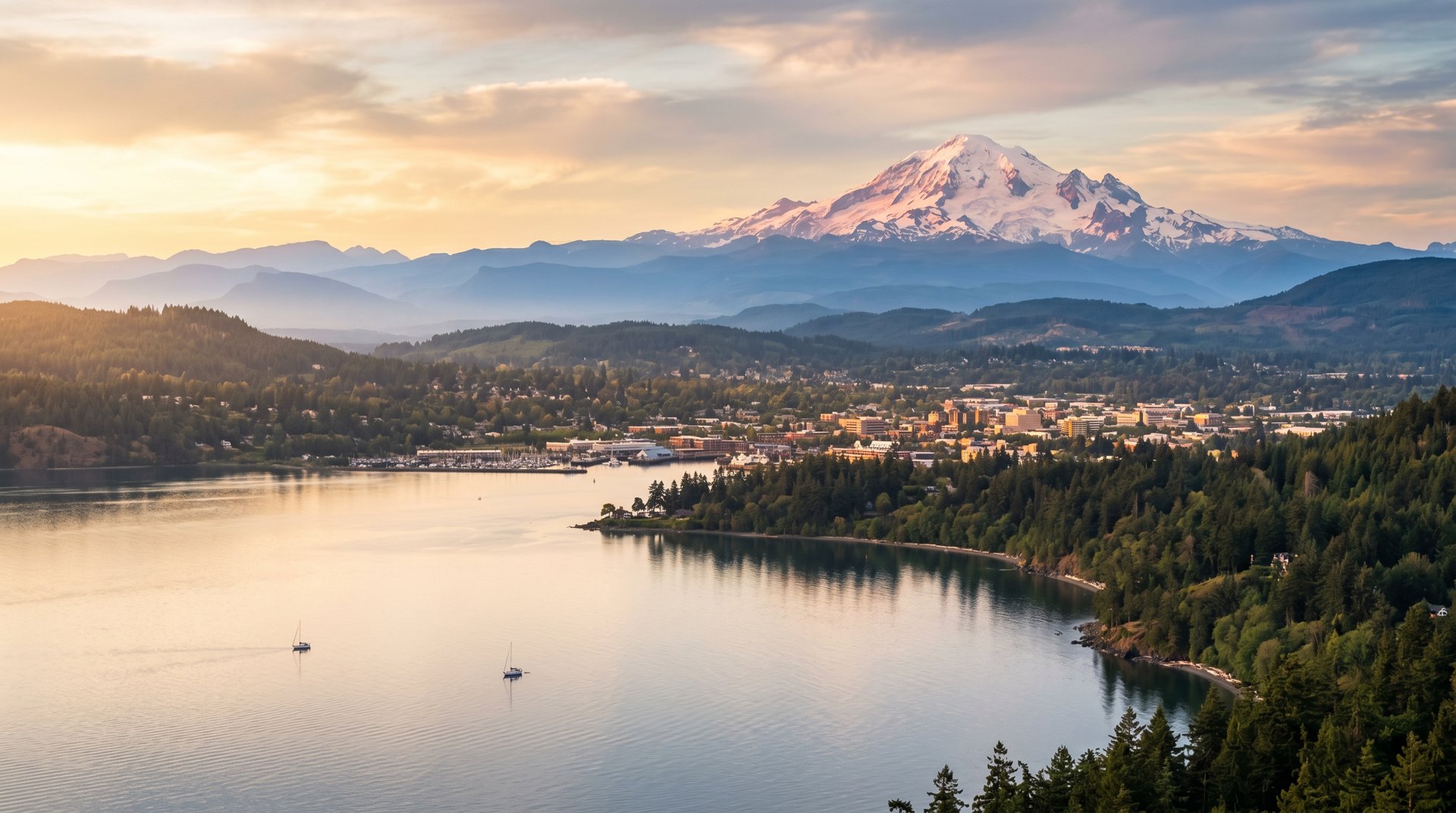
People call me from Clark County more than I’d have expected three years ago. They’re not confused about taxes — they already live in Washington, they know the deal. What they’re done with is the orbit. The Portland orbit: morning gridlock stacking up over the I-5 bridge, the sense that every neighborhood decision revolves around what’s happening fourteen miles south in a city that’s been grinding through hard years. They want smaller. They want the bay at the door, not the freeway. And when I describe what Bellingham looks like on a July Tuesday — paddleboards off Squalicum, Mt. Baker sitting white above the foothills, a town of 98,000 that doesn’t feel like a satellite of anything — something unlocks. The math is almost identical between here and Clark County. The life is not.
The equity reset, in actual numbers

Let me put the numbers on the table without flinching, because this move is not driven by financial arbitrage — it’s driven by lifestyle — and you deserve to know exactly where you stand going in.
Clark County’s median single-family sale price as of early 2026 is around $549,000 (The Columbian, February 2026, reporting January 2026 median). Bellingham’s median for the same period is approximately $710,000 (Redfin, Q1 2026). That’s roughly a $100,000 step up — real money that you either need to cover with your Clark County equity or accept as a slightly larger loan.
Here’s a worked equity example: Sell your Vancouver WA home at the $549K median. After 5–6% selling costs (commission, excise tax, closing), you net roughly $521,000. Use $104,000 as a 20% down payment on a $520,000 Bellingham home in a mid-tier neighborhood (South Hill, Barkley, Columbia) and you’ve preserved your equity, kept a manageable mortgage, and exited the Portland orbit. Or you stretch to a $649,000 home — Edgemoor lot, views of the bay — put 20% down ($130,000) and walk away with roughly $391,000 applied to the loan. None of that requires you to give up wealth. It requires you to not overcorrect and treat this like a California-to-Bellingham windfall trade. It isn’t.
What IS neutral: every major financial structure stays the same. Both cities are in Washington. You’re not crossing a state tax line.
| Vancouver WA | Bellingham WA | What’s different | |
|---|---|---|---|
| Median home price | ~$549,000 | ~$710,000 | Bellingham ~18% higher |
| Property tax (effective) | ~0.90–0.99% | ~0.85% | Bellingham slightly lower |
| State income tax | 0% | 0% | Identical |
| Sales tax | 8.9% (City of Vancouver, 2026) | 8.8% | Near-identical |
| Typical peak commute | I-5 south to Portland, 30–90 min depending on time | Scattered local; SEA airport 1.5 hrs | Portland commute gone |
| Gas (regular avg) | ~$3.90–4.10/gal (PNW average) | ~$3.90–4.10/gal | Near-identical |
| Groceries vs national avg | ~6–8% above national | ~5–7% above national | Comparable, both PNW-premium |
| Distance to major airport | 15 min to PDX (major hub) | 1.5 hrs to SEA (major hub) | Bellingham airport is small |
The honest bottom line: you’ll probably spend 15–20% more on housing unless you move to a neighborhood priced under Bellingham’s median (several are). Every other cost line is a wash.
Cost of living, line by line
Because both cities sit in Washington state and the Pacific Northwest cost basin, there are no dramatic differences in day-to-day spending — and that’s worth saying plainly so you’re not surprised either direction.
Housing is where the gap shows, and we covered that above. The $100,000 median difference is real, though it compresses if you’re comparing specific neighborhoods rather than city medians. Parts of Bellingham’s east side (Columbia, Roosevelt) have inventory that prices closer to Clark County.
Property taxes are actually slightly kinder in Whatcom County. Clark County’s effective rate runs 0.90–0.99% depending on your location within the county — City of Vancouver at the higher end, Battle Ground toward the lower end. Whatcom County’s effective rate is approximately 0.85%. On a $650,000 purchase in Bellingham, that’s roughly $5,525/year — marginally less than you’d pay on that same value in Vancouver WA.
Groceries are roughly comparable — both cities sit about 5–8% above the national average as typical PNW markets. Bellingham’s Fred Meyer and Costco (yes, there’s a Costco) price similarly to what you’d find in Clark County. You lose the ability to drive across the river to Oregon and take advantage of Oregon’s 0% sales tax on major purchases. That’s a real, if modest, loss.
Utilities in Vancouver WA run slightly below the national average (roughly 7% under) because Clark Public Utilities is a PUD with competitive rates. Bellingham’s utilities (PSE for gas, Puget Sound Energy) are competitive but not notably cheap. Plan on similar or very slightly higher utility costs.
Transportation costs may actually decrease if your current life involves daily Portland commutes. Parking, wear on your vehicle, and the cost of two-bridge stress all drop when your commute collapses from 45 minutes to 12.
Dining and services are similar. Bellingham has fewer large chain options than the Portland metro, which cuts both ways: less competition on price, but also a genuinely distinct local restaurant scene centered on Railroad Avenue and Fairhaven that Vancouver WA residents often find more interesting than Clark County’s suburb-strip options.
The net: you’re not moving for cost savings. You’re moving for something else. The finances need to support that, and for most Clark County homeowners, they do.
The climate — the honest part

I’m not going to sell you on the sun here, because this is not a sun story.
Vancouver WA and Bellingham share the same fundamental climate character: maritime Pacific Northwest, meaning overcast, gray, and wet from October through April. If you’ve lived in Clark County for any length of time, you know the drill. The difference is degree and summer ceiling, and one matters.
Vancouver WA climate: ~42 inches of rain per year, approximately 143 fully sunny days annually. July peaks average 77°F, August can touch 81°F, with documented heat events hitting 100°F+ during heat domes — Clark County experienced brutal heat dome conditions in 2021, with Portland metro temperatures reaching 116°F. January lows sit around 34°F, with occasional ice and snow. The Gorge influence creates its own wind and weather dynamics.
Bellingham’s climate: ~36 inches of rain per year, approximately 230 cloudy/gray days annually (more overcast than Vancouver WA, though often drier in summer). July highs average 72°F; you rarely see 90°F. January lows average 35°F — essentially identical to Vancouver WA winters. The big difference is summer: Bellingham’s ceiling is cooler and more reliable. No heat domes. No weeks of triple-digit ambient temperature radiating off pavement.
That summer difference is not trivial. When you’ve sweated through a Clark County August heat event and then spent a Bellingham July with your windows open and a breeze off the bay, the tradeoff becomes clear. You trade a few more gray days in February for summers that are genuinely livable without central air.
The honest advice I give every Clark County buyer: come in November. Not because November is beautiful — it’s not, the mountains are often socked in and the light is low by 4pm — but because you need to know what you’re signing up for before committing. If you visit in July, you’ll move here and spend February wondering what you’ve done. If you visit in November and you’re still drawn to the town, the craft breweries, the walkable waterfront, the company of people who actually like living somewhere that isn’t scorching — you’ll be fine.
The gray is real. For people coming from Phoenix or LA, it’s a genuine adjustment. For people coming from Clark County, it’s the same gray season, slightly longer, with cooler summers as your reward.
Why people leave Vancouver WA
This section isn’t an indictment — Clark County has built genuine community over the past two decades and there are plenty of people who love it. But you asked, so here’s what I actually hear when buyers call me.
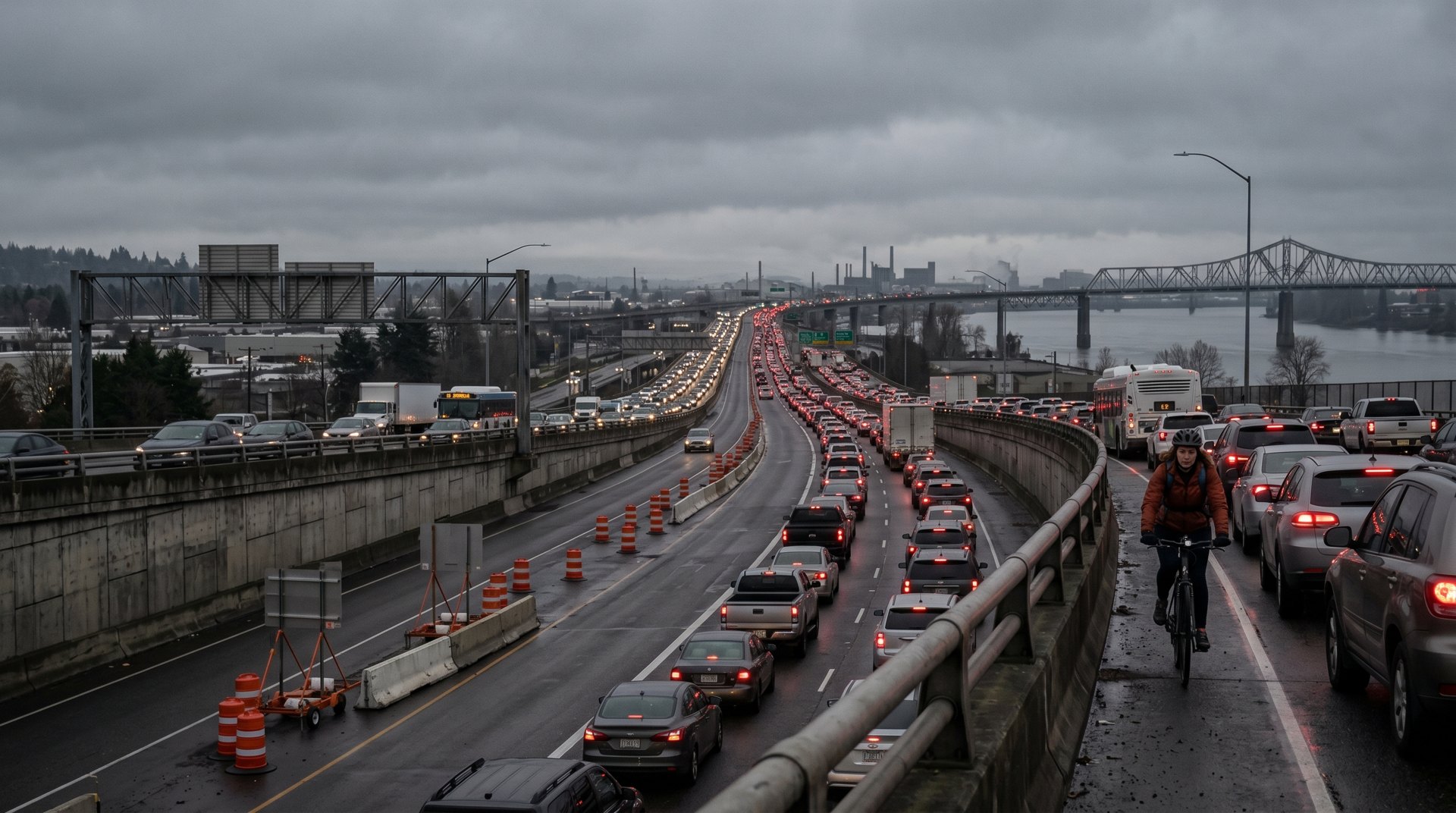
The Portland commute has become untenable. The I-5 corridor between north Vancouver and the Fremont Bridge is one of the most congested stretches in the Pacific Northwest. Morning southbound from Salmon Creek to Portland can take 60–90 minutes on a bad day. By 2045 projections, that commute is expected to double from current times without significant infrastructure changes — and the Interstate Bridge replacement project has moved slowly. If your work requires Portland presence, you are genuinely stressed by this. People who went remote during COVID and have stayed remote are the first to leave.
The Portland orbit got heavier. Vancouver WA’s identity was always complicated by its relationship to Portland — everything from entertainment to employment to cultural life skewed south. As Portland has worked through well-documented challenges around homelessness, public safety, and downtown vitality over the past five years, some of that pressure has spilled north. Homeless encampments visible around Vancouver WA, higher-than-average property crime, and a sense that the city is absorbing Portland’s problems without Portland’s resources have pushed long-time residents to reconsider.
Schools are a persistent stress point. Clark County school district budget cuts and labor tensions have been a recurring story. Families with school-age children who are willing to do the research often find Bellingham Unified, Ferndale, and Lynden districts to be meaningfully more stable.
Population growth outpaced infrastructure. Clark County’s growth has been aggressive — the county added housing faster than roads, parks, and services could follow. Bellingham has its own growth pressures (it’s a genuine housing crisis in its own right), but the city’s smaller scale and planned downtown make the density feel more manageable.
The summers hit differently. After enough years of July heat events and August smoke from Eastern Washington and Oregon wildfires drifting into the Columbia River Gorge, people want the 72°F ceiling of a bay-front town more than they want proximity to a wine country weekend.
Commute reality — can you still work?
The first thing most Clark County buyers ask is: “Can I still get to Portland when I need to?” The honest answer is no — not conveniently.
Bellingham to Portland by car is approximately 4 hours and 10 minutes, non-stop, on I-5 south through Seattle and Olympia. That’s a meaningful trip, not a day-commute. If your work requires regular Portland presence — weekly or more — Bellingham won’t work unless you’re flying.
Flying PDX to BLI: There is no direct BLI-PDX route. You connect through Seattle (SEA), which adds time and cost. Budget at least 3–4 hours door-to-door including drive to BLI, security, and connection. Flying from SEA is faster if you’re willing to make the 1.5-hour drive south first. PDX-SEA flights run frequently; BLI serves fewer routes overall.
The airport adjustment is real. PDX is a major international hub with 50+ nonstop destinations and competitive pricing. BLI is a small regional airport with Alaska, United, and Allegiant service — maybe a dozen destinations nonstop. For serious travel needs, you budget Seattle trips. Most Bellingham buyers who came from high-travel careers either adjust their travel patterns or accept SEA as their home airport. It’s not deal-breaking; it is a real change.
Remote work is the great equalizer. The majority of Clark County buyers who’ve completed this move in the past three years are either fully remote or 80%+ remote. If that’s your situation, the calculus is simple: your daily commute collapses from I-5 to a 12-minute drive across town or a walk to a coffee shop on Railroad Avenue, and you gain a lifestyle dividend that doesn’t show up on any cost-of-living index.
Seattle corridor: Bellingham’s geographic position puts Seattle at 1.5 hours south — meaningfully closer than Portland is from Vancouver WA. If Seattle-based employers or clients matter to you, Bellingham actually works better than Clark County for that relationship.
Buying a home here without flying up six times
Vancouver WA buyers are at a genuine logistical advantage compared to, say, California or Texas buyers: you’re a single day’s drive away. That changes what’s possible.
The typical process for Clark County buyers:
-
Discovery call first. Before you drive four hours, spend 30 minutes with me on video. I’ll tell you which neighborhoods match your life, what’s actually in your price range right now, and whether the move makes sense. Half of first calls are reality checks that save both of us time.
-
NWMLS listing alerts. You go on my active search list and get every qualifying listing the moment it hits — same access I have. The Bellingham market moves fast enough that you need visibility before something goes under contract over a weekend.
-
Virtual showings. I do full-walk video tours with narration. Not the sales-speak version — I’ll tell you about the noise from the arterial two blocks east and whether the yard drainage looks sketchy. You can go through three or four homes in an hour on video and cut your shortlist before you drive up.
-
The 1–2 day scouting trip. When you have 3–5 homes worth seeing in person, book a weekend. I block a Saturday morning for home tours and we do a neighborhood drive afterward. By Sunday afternoon you have enough information to make a real decision.
-
Offer and inspection. Washington earnest money is typically 1–3% of purchase price, deposited after mutual acceptance. You keep a standard inspection contingency — 10 business days is common. Your inspector goes through the home on your behalf; you can attend or review the report remotely. Chicago Title (my go-to escrow, Bellingham office) handles the title work and can coordinate a remote or mail-away closing if you’re back in Clark County.
-
Timing the Clark County sale. Because you’re in-state, your Clark County broker and your Bellingham transaction run on the same timeline conventions. No foreign-state complications, no different closing disclosure rules. You can coordinate a same-day or next-day close on both sides with relative precision. Most Clark County buyers either close Clark County first and rent briefly, or negotiate a possession date that floats 2–3 weeks to allow overlap.
WA Real Estate Excise Tax (REET) applies on both sales at the same graduated brackets. You already know how this works. No surprises.
Schools — the comparison families ask about
Clark County school district challenges — budget shortfalls, labor tensions, the political volatility around curriculum — have pushed more than a few families into the Bellingham conversation. Here’s what you’re looking at on the other end.
Bellingham School District serves the city proper. WWU’s presence means strong arts, humanities, and STEM threads throughout the district. Test scores and graduation rates are above state average. The district is not without its own budget pressures (every WA district is), but the political environment is more stable.
Ferndale School District is 15 minutes north of downtown Bellingham and is one of the stronger performing districts in Whatcom County — particularly for families who want slightly more suburban density without leaving the Bellingham metro area. New construction and strong community investment.
Lynden School District is 25 minutes north and is consistently among the top-performing districts in Whatcom County by test score and graduation rate. More conservative community character, strong athletics and agriculture heritage. Families who want top academic performance and a quieter, small-town feel often land here.
Western Washington University (WWU) shapes Bellingham’s education culture in ways that ripple down. The university brings faculty families, visiting researchers, and a generally education-oriented adult population. That matters for the cultural environment your kids grow up in.
If your Clark County move was partly driven by school concerns, Whatcom County offers real alternatives. Book a call with me and I’ll connect you with families who’ve made this transition — people with school-age kids who can give you the unfiltered version.
Five Bellingham neighborhoods Vancouver WA buyers tend to land in

Clark County buyers generally come with two instincts: they want to feel the independent-small-city character of Bellingham (not a suburb), and they don’t want to sacrifice convenience. These five neighborhoods land well.
Fairhaven (/neighborhoods/fairhaven/) — Bellingham’s historic south village. Cobblestone streets, independent bookstores, restaurants that have been here 20 years, and a genuine village-within-the-city feel. Homes run $700K–$1.1M+. Buyers who are leaving Clark County’s suburban sprawl and want something that feels like a real place — walkable, charming, self-contained — land here first. The tradeoff: it’s the priciest neighborhood and inventory is tight.
South Hill (/neighborhoods/south-hill/) — Bellingham’s family stronghold. Good schools, larger lots, quieter streets, views of the bay from the upper elevations. Homes in the $550K–$800K range. Clark County families with kids looking for the equivalent of a stable suburban neighborhood find South Hill most familiar in feel, while still being minutes from downtown Bellingham. It doesn’t feel like a Portland suburb because it has nowhere near the density — it feels like a small Pacific Northwest town, which is exactly what it is.
Edgemoor (/neighborhoods/edgemoor/) — The quiet, established neighborhood on Bellingham Bay’s west side. Mid-century homes, large lots, older tree canopy, incredible water and island views from the upper streets. Prices run $750K–$1.2M. Buyers who want space, privacy, and to wake up to the San Juans on a clear day end up in Edgemoor. Inventory is rare; when something comes available, it goes fast.
Barkley (/neighborhoods/barkley/) — Practical, convenient, lower price point ($480K–$680K range). Close to I-5 for the SEA airport run, good school access, strong retail and services nearby. Buyers who are less interested in the “Bellingham lifestyle brand” and more interested in getting good value and quick logistics often land in Barkley. Clark County buyers who are more accustomed to suburban infrastructure find it most immediately comfortable.
Columbia (/neighborhoods/columbia/) — Central Bellingham, walkable to downtown and WWU, mix of older craftsman homes and newer infill. More urban feel, higher density, great for people who want to walk to coffee or dinner. Prices $500K–$750K. Clark County buyers who are younger, more lifestyle-oriented, or who came from Portland proper (not just Portland-adjacent Vancouver) often gravitate here for the walkability and independent-business density.
The lifestyle shift — what changes
The most concrete thing I hear from Clark County buyers six months after moving is: “I forgot what it felt like to not be driving to somewhere else.”
Vancouver WA’s life gravity pulls south. Portland has the concerts, the restaurants, the airport, the cultural events. You live north of the river and commute to the actual city for the good stuff. That relationship is baked into how Clark County residents organize their time.
Bellingham doesn’t have a Portland to defer to. Everything you’re going to do is either here or requires an intentional trip. That sounds like a limitation until you realize it means you stop spending your free time on the I-5.
What fills the vacuum: the Chuckanut Drive to Skagit Valley, the Saturday market, the ferry to the San Juans, Mt. Baker on a clear January day, Fairhaven’s coffee shops full of people who chose small-city life intentionally. A kayak in Squalicum Harbor on a Wednesday evening after work. The North Cascades an hour east if you want to disappear into the backcountry for a weekend.
The pace is slower. That’s not marketing copy — it’s just smaller city reality. The tradeoff: you lose the pulse of a major metro and its energy, concerts, restaurants, and professional density. If you need a city to feel alive, Bellingham won’t fix that. If you’re ready to stop needing a city for that, it’s the right place.
Frequently asked
Is the Vancouver WA to Bellingham move a wash financially, or do I take a hit?
It’s close to a wash if you’re comparing Clark County property against Bellingham’s mid-range neighborhoods. The median price gap (~$100,000 right now) means you’re not extracting a big equity windfall like California buyers do — you’re reallocating roughly the same capital into a different market. Property taxes are marginally lower in Whatcom County. No income tax change (both 0%). Sales tax is near-identical. The financial case is neutral; the lifestyle case has to carry the decision.
What’s the real winter like compared to Vancouver WA?
Honestly similar. Both cities are marine PNW — gray, overcast, wet from October through April. Bellingham gets slightly more overcast days but slightly less total rainfall (36″ vs 42″/year). The cold is nearly identical — January lows around 34–35°F in both cities. The meaningful difference is summer: Bellingham’s summers are cooler (July highs averaging 72°F vs Vancouver WA’s 77–81°F) and Bellingham has no heat dome exposure. If Clark County’s brutal summers were part of your push factor, Bellingham’s climate pays off immediately.
Can I still get to Portland easily after the move?
No, and you should go in clear-eyed about that. Bellingham to Portland is approximately 4 hours and 10 minutes by car. There is no direct flight. If you have family in Clark County or regular Portland business commitments, plan on intentional trips — not casual “I’ll drive down Sunday” visits. Buyers who fully disconnect from the Portland orbit adapt well. Buyers who underestimate how much Portland was still woven into their life sometimes regret the distance in year one.
What’s it actually like to buy here without being local?
More manageable than most out-of-state moves because you’re already in Washington and the 4-hour drive is doable. I typically walk Clark County buyers through 2–3 video tours, one weekend scouting trip, and then an offer — total elapsed time from first call to under contract averages 6–10 weeks depending on market conditions and your flexibility. Remote closings are standard in WA. Chicago Title coordinates everything. The only thing harder than a local buyer is the touring limitation, which video largely solves.
What’s the catch with Bellingham?
The honest answer: the job market is thinner. Bellingham is a college town with a healthcare anchor (PeaceHealth), some manufacturing, some tech spillover from Seattle, and a lot of small businesses. If you need a deep professional job market with multiple employers in your field, Bellingham may not support your career. Remote workers sidestep this entirely. Career-transition people sometimes struggle. The airport limitation (no PDX direct, SEA is 90 minutes away) is real. And the housing market is tight — inventory is chronically low, and when something good comes up, multiple offers happen.
Is Bellingham politically comfortable for Clark County transplants?
Bellingham leans progressive — it’s a university town and that shapes the civic culture. Clark County is more politically mixed; you likely have neighbors across the political spectrum right now. Bellingham is more consistently center-left to progressive in its municipal politics. Ferndale and Lynden, 15–25 minutes north, have more politically diverse and conservative communities if that matters for where you settle. Most Clark County transplants find Bellingham comfortable regardless of their own politics — the community isn’t ideologically aggressive, just tilted.
How different is Mt. Baker from Mt. Hood for skiing?
Very different in character. Mt. Hood (Timberline, Mt. Hood Meadows) is a larger, more developed ski resort with better infrastructure, more terrain variety, and deeper snow sports culture. Mt. Baker is rawer — it holds world records for annual snowfall, it has a dedicated backcountry-adjacent culture, and it feels like you’re skiing a real mountain rather than a resort. Smaller, fewer lifts, less après-ski development. Baker regulars tend to be more experienced skiers who prefer solitude over services. If you skied Hood casually, Baker is a different experience — get comfortable with the access road and weather variability before committing.
Should I sell my Clark County home before going under contract in Bellingham?
Usually no, but it depends on your equity and loan position. Most Clark County buyers make an offer in Bellingham contingent on their Clark County home selling — a home-sale contingency — which sellers in a competitive market will sometimes decline or negotiate. Stronger buyers use a bridge loan or home-equity line to make a non-contingent offer in Bellingham and then list Clark County after going under contract. I walk every buyer through the specific mechanics on our first call based on their equity position and risk tolerance. There’s no universal right answer, but there are better and worse paths for your specific situation.
Thinking about Bellingham?
Tell me where in Vancouver WA you’re coming from, your budget, and how you work, and I’ll send two or three neighborhoods that fit plus what’s active. If you have a place to sell first, a home valuation is the place to start.