


CHICAGO → BELLINGHAM · RELOCATION GUIDE
From Chicago to Bellingham.
The honest math.
No state income tax, property taxes cut in half, and milder winters — the full financial picture from a broker who’s done this move dozens of times.
The Chicago-to-Bellingham call is one I take a few times a month, and it has a flavor all its own. Chicagoans aren’t fleeing a place they hate — most of them love their city, the neighborhoods, the food, the lake in July. What’s pushing them is the arithmetic: a Cook County property tax bill that climbs every reassessment, a 4.95% state income tax that Washington simply doesn’t charge, a 10.25% sales tax on everything they buy, and four-month winters that start with lake-effect snow in November and don’t fully let go until April. I’m Genaro Shaffer, a licensed broker here in Bellingham — WA License #27119, Bellwether Real Estate, 11+ years and 67+ closings. Here’s the complete picture for buyers coming out of Chicago, the suburbs, or anywhere in Cook, DuPage, Lake, or Will County.
The equity reset, in actual numbers

For a Chicago buyer, the headline isn’t property tax — it’s the income tax you stop paying the day you become a Washington resident. Illinois charges a flat 4.95% on every dollar of taxable income, no brackets, no top-out. Washington charges zero. On a household earning $150,000, that’s roughly $7,400 a year you keep — every year, forever, before you’ve saved a dime on anything else. That single line is the financial spine of this move, and it’s why the Chicago math often works even when the home prices look close.
What Chicago-area homes are selling for right now (spring 2026):
| Chicago-area market | Median sale price (Q2 2026) | Net to seller (after ~6% costs) |
|---|---|---|
| Chicago (city) | ~$420,000 | ~$395,000 |
| Cook County (overall) | ~$389,000 | ~$366,000 |
| North Shore / DuPage (typical SFR) | ~$500,000–$650,000 | ~$470,000–$611,000 |
| City single-family (detached) | ~$450,000+ | ~$423,000+ |
Sources: Redfin Cook County and Chicago metro data, May 2026. Single-family detached homes have appreciated faster than condos.
Bellingham median single-family home: approximately $640,000–$700,000 (Redfin reported $630K for the city in May 2026; local reporting has put the Bellingham median at $700K on different data cuts). I’ll use $650,000 as the working figure with closing costs around 1.5% ($10K).
The worked equity example:
Take a typical North Shore or DuPage seller who nets $525,000 after costs. Against a $650,000 Bellingham purchase, that’s a $125,000 gap — comfortably covered with a 25% down payment ($162,500) and roughly $362,000 left to finance, which most relocating households qualify for easily. A city seller netting $395,000 is looking at a $255,000 gap to the median; that’s a 20%-down purchase on $650K ($130,000 down) with the balance financed, or a reason to buy in Bellingham’s $500K–$575K tier, which absolutely exists. The buyer who really comes out ahead is the longtime owner — someone who bought a Lincoln Park two-flat or a Naperville colonial fifteen years ago and is sitting on $400K–$600K of equity. That seller often lands in Bellingham with the house bought outright or close to it, and then never writes an Illinois income-tax check again.
The home prices are closer than the California version of this move. What tilts the whole thing is the stack: no income tax, a property tax bill that drops by half or more, and a winter that’s gray instead of dangerous.
The comparison table:
| Chicago / Cook County | Bellingham WA | What changes | |
|---|---|---|---|
| Median home price | ~$389K–$420K (city) | ~$650K | Higher purchase price |
| Property tax (effective) | ~1.66% city / ~2.14% county median | ~0.70%–0.77% | ↓↓ roughly half |
| Annual tax on a $500K home | ~$8,300–$10,700 | ~$3,500–$3,850 | ~$5,000–$6,500/yr saved |
| State income tax | 4.95% flat | 0% | ↓↓ ~$7,400/yr on $150K income |
| Sales tax (combined) | 10.25% | ~8.8% | ↓ lower in Bellingham |
| Gas (per gallon, June 2026) | ~$4.69 (IL avg) | ~$5.67 (WA avg) | ↑ higher in WA |
| Groceries | ~3.5%–3.8% above national | Near national avg | ↓ slightly cheaper |
| Annual snowfall | ~37″ | ~8″–12″ (city) | ↓↓ far less snow |
| Summer high (July avg) | ~82°F–84°F (humid) | ~72°F (dry) | ↓ cooler, less humid |
| Winter low (January avg) | ~17°F–23°F (lows to ~14°F) | ~35°F | ↑ much milder |
The 20-year tax math:
On a $650K Bellingham home at 0.77% effective: about $5,000/year in property tax. A comparable Cook County home at 2.0%+ effective would run $10,000–$13,000/year. Call the property-tax difference $5,500/year and add the income-tax savings — on a $150K household, another ~$7,400/year. That’s roughly $12,900 a year that stays in your pocket. Even before any investment growth, that’s $258,000 over twenty years. Invested at a 7% historical return, the compounded figure is well into the high six figures. This is the part of the move that doesn’t show up on closing day but quietly reshapes your finances every year you own the house.
Cost of living, line by line
Chicago buyers tend to assume the West Coast will be more expensive across the board. On housing, often yes. On taxes, emphatically no. Here’s the honest breakdown of what actually changes basket to basket.
What gets cheaper:
Income tax. The big one. Illinois takes 4.95% of everything you earn; Washington takes none. For a dual-income professional household, that’s frequently the single largest line-item swing of the entire move, and it recurs every year.
Property tax. Cook County’s effective rates are among the highest of any large county in the country — the county median runs north of 2%, and the city’s median bill jumped 16.7% in a single recent tax year. Whatcom County runs roughly 0.70%–0.77%. On equivalent home values, your bill drops by half or more, and Washington’s levy structure rises far more slowly than Cook County’s reassessment cycle.
Sales tax. Chicago’s 10.25% combined rate is one of the highest of any major U.S. city. Bellingham sits around 8.8%. On a $40,000 car that’s about $580 saved at the dealership; across a year of normal spending it adds up.
Heating and snow costs. You stop paying to dig out. No more $400 snowblower repairs, no plowing contracts, no four months of running the furnace against single-digit nights. Bellingham winters are mild enough that heating bills are modest and the snow shovel mostly stays in the garage.
What gets more expensive:
Gas. Washington’s gas taxes and West Coast distribution push pump prices well above Illinois — roughly $5.67 versus $4.69 a gallon in early June 2026. You’ll feel this one at every fill-up, though Bellingham’s short distances soften the blow.
Housing, depending on where you’re coming from. If you’re selling a city condo or a modest Cook County house, Bellingham’s $650K median is a step up in price. If you’re selling North Shore, DuPage, or a detached city home, it’s roughly a wash or a step down.
Real estate excise tax (REET). Washington charges a graduated REET on the seller at sale (1.1%–3.0%). Illinois transfer taxes exist but Washington’s bite is larger on the eventual sale — worth knowing for when you sell again.
Eating out. Chicago is a genuinely great restaurant town at every price point, and Bellingham can’t match that range. Mid-tier dining here is comparable in price; Washington’s higher minimum wage shows up in check totals. The depth of options is the bigger loss, not the cost.
Net: groceries and utilities are a near-wash, gas is worse, restaurants are thinner — and taxes are dramatically better. For most Chicago households the tax side outweighs everything else.
The climate — the honest part

This is the trade most Chicagoans actually find easy to stomach, because they’re not coming from a gentle climate. You already know hard winter. The question is whether you’ll mind trading a bright, brutal winter for a gray, mild one.
Chicago winters are no joke and you know it. January averages a low around 17°F–23°F, regularly dips to 14°F or below, and the wind off the lake makes it feel worse. Annual snowfall runs about 37 inches, and lake-effect bands can dump heavily with little warning. The polar-vortex stretches — days where the actual air temperature sits below zero — are a recurring feature, not a freak event. Then there’s the flip side: Chicago summers can be genuinely hot and sticky, with July highs in the low-to-mid 80s, humidity off the lake, and stretches that push past 90°F.
Bellingham winters are a completely different animal — milder but grayer. The city averages only 8–12 inches of snow a year, and most of it melts within a day or two. Temperatures rarely drop below the high 20s. There’s no polar vortex, no week of sub-zero air, no wind chill that hurts to breathe. What there is instead is cloud. Bellingham sees on the order of 230 gray or overcast days a year — that’s the honest number. Rain is light and persistent (about 36 inches spread across nine or ten months) rather than the heavy downpours you might picture. Chicagoans handle the cold fine; the adjustment here is the lack of sun, not the temperature.
Bellingham summers are the payoff, and they’re spectacular. July and August highs average around 72°F with low humidity and long, late-setting daylight. No air conditioning required in most homes. After a Chicago August spent dodging heat-and-humidity advisories, a dry 72°F afternoon on Bellingham Bay feels like a different planet — and it’s the season people fall in love with on their first visit.
My honest recommendation: come up in November or February, not July. Summer sells itself. If you can walk Fairhaven in a January drizzle, eat at one of the good restaurants, watch the fog sit on the bay, and still feel at home — you’re ready. Chicagoans actually pass this test more often than buyers from sunnier states, because you’re already used to choosing your home for reasons other than the weather. But know which kind of buyer you are before you list the house. A vitamin D supplement and a full-spectrum light are practical PNW tools, not jokes.
Why people leave Chicago
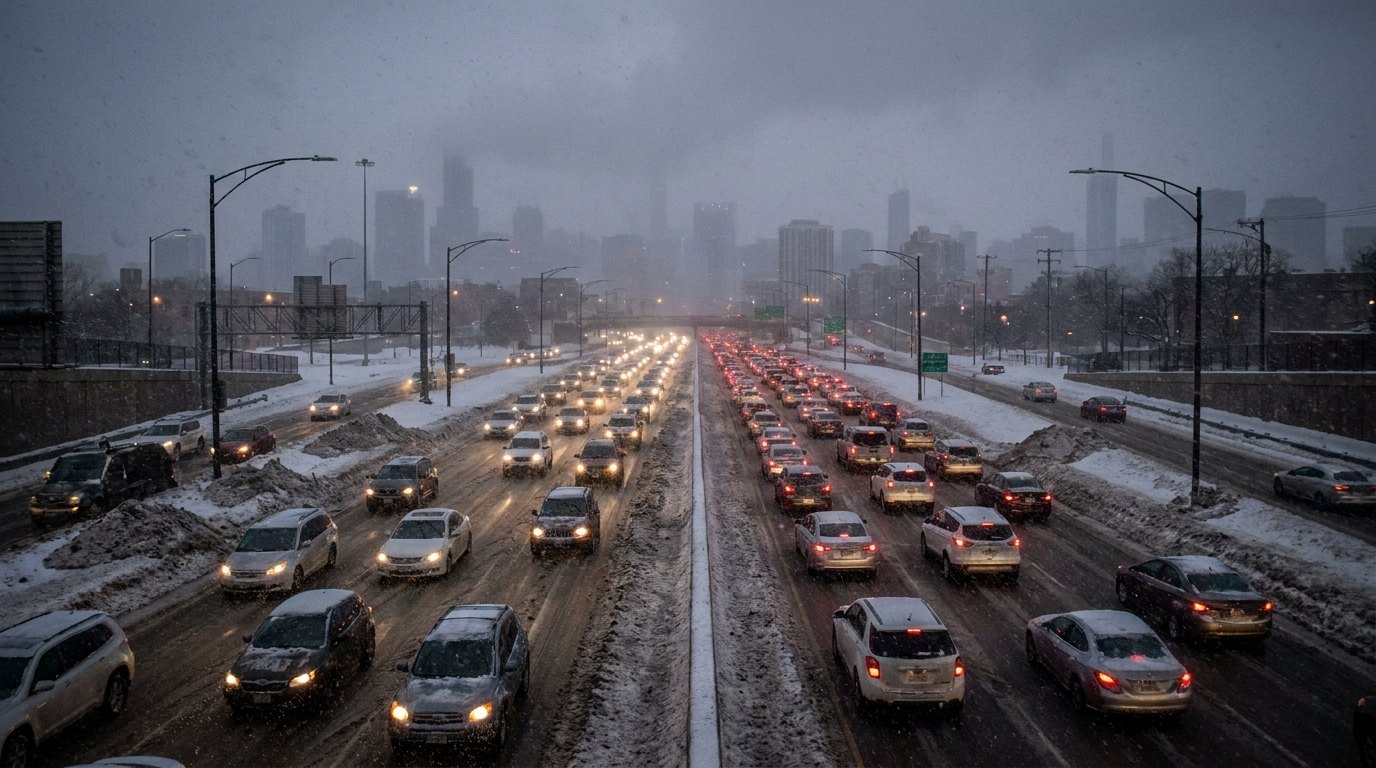
I’ll be straight: I’m not in the business of trashing Chicago. It’s one of the great American cities and most of my Chicago clients say so on the way out the door. But something is moving people, and it’s specific.
The tax stack. This is the one I hear first, almost every time. A 4.95% flat state income tax, a 10.25% Chicago sales tax, and Cook County property taxes that ratchet up with every reassessment. The 2024 city tax year brought a record 16.7% jump in the median residential bill. For homeowners on the South and West Sides, recent analyses found some of the steepest increases. Even people who can comfortably afford it describe the same feeling: the bill never stops climbing, and you stop trusting the next one.
The winter’s length, not just its bite. Chicagoans don’t fear cold — they fear November-through-April. It’s the grind of five months of furnace, ice, and gray-brown slush, the salt on the cars, the dark commutes at both ends of the day. People reach a point where they’ve simply done it enough times.
Cost and density pressure. Parking, congestion on the Kennedy and the Dan Ryan, the cost of a single-family home in a neighborhood with the schools you want. For families especially, the math of staying in a good city district versus what the same money buys elsewhere starts to feel lopsided.
Property-tax-driven equity decisions. A lot of my Chicago sellers aren’t unhappy — they’re strategic. They’ve watched their home appreciate, they’re carrying a five-figure annual tax bill, and they realize they can convert that into a paid-off house in a low-tax state and pocket the income-tax savings on top. It’s less “escape” than “cash out and breathe.”
None of this requires disliking Chicago. Most people leave with affection and a little regret. They just run the numbers and decide the next chapter pencils out better somewhere quieter.
Commute reality — can you still work?
Most Chicago-to-Bellingham buyers I work with are remote or hybrid, and that’s the pattern that works best. Here’s the logistics.
Remote work from Bellingham: Chicago runs on Central time; Bellingham is Pacific, a two-hour gap. A Loop professional on a standard 9–5 CST schedule starts the Bellingham day at 7 AM PST — early, but it frees up long afternoons. If your team or clients are East Coast, you’ll start earlier still. The time-zone shift is a real thing to plan around, not a dealbreaker, and plenty of my buyers find the early start actually suits Bellingham’s outdoor lifestyle: work wraps with daylight to spare.
Flying back to Chicago: This is one of the genuine advantages of leaving Chicago specifically. O’Hare and Midway are major hubs, so getting back is easy and cheap. Sea-Tac (SEA) to Chicago O’Hare (ORD) is a nonstop of roughly 4 hours 40 minutes, with multiple daily flights on several carriers. If you’ve got family or a board seat that pulls you back to Chicago monthly, this is about as convenient as long-distance relocation gets.
SEA versus BLI: Sea-Tac is the workhorse airport for Chicago travel — it’s about 90 miles south of Bellingham, a 1.5–2 hour drive down I-5 depending on traffic, with nonstop service to both Chicago airports. Bellingham International (BLI) is a small, easy regional airport with Allegiant and limited Alaska service — great for cheap direct hops to Las Vegas, Phoenix, and a few California cities, but not your Chicago connection. For Midwest business travel, plan on SEA.
Driving distance: Chicago to Bellingham is roughly 2,100–2,150 miles by road — about a two-and-a-half day drive. This is a move you fly for and ship the rest. Vancouver, BC sits just 50 miles north of Bellingham, and Seattle’s full job market (Amazon, Microsoft, Costco, Boeing) is within commuting range for hybrid roles.
For the non-remote buyer: Bellingham’s local economy is anchored by healthcare (PeaceHealth is the largest employer), Western Washington University, retail, and maritime trades. It is a smaller professional market than Chicago by an order of magnitude. If you need local W-2 work outside those sectors, that’s a real constraint to plan around — the salary ceiling is lower, and the cost-of-living offset helps but doesn’t fully close it.
Buying a home here without flying up six times

About a third of my Chicago buyers close on a home they’ve seen once in person, and a few close having never set foot in it. The remote process is more manageable than it sounds.
The remote-buyer workflow I use:
We start with a 30-minute video call — your situation, timeline, budget, dealbreakers. From there I set up NWMLS listing alerts filtered to your exact criteria, so you get daily digests of new listings and price changes. When something looks right, I do a FaceTime or Zoom walkthrough: I walk every room, open every door, go up into the attic, and narrate the condition honestly — including the things a listing photo hides. If you’re seriously interested, I follow up with my own read on the street, the lot, the neighbors, and what I’d think twice about.
When you’re ready to see your short list in person, the typical Chicago buyer flies in for a focused 2–3 day trip: in Thursday, six to eight homes Friday and Saturday, home Sunday. That’s enough to make a real decision.
Washington purchase mechanics:
Earnest money in Washington typically runs 1%–3% of the purchase price — on a $650K home, $6,500–$19,500 held by the escrow/title company (I work with Chicago Title’s Bellingham team). Inspection contingencies are standard and meaningful: if the inspection turns up problems you don’t accept, you get your earnest money back. The inspection period usually runs about 10 business days. Closing remotely is routine — DocuSign handles the paperwork, and a mobile notary can come to you anywhere in the Chicago area for the final signature.
Coordinating the Chicago sale:
Most buyers want their Chicago home closed before or simultaneously with the Bellingham purchase. If timing forces your hand, a bridge loan or a HELOC against your Chicago equity can fund the Bellingham purchase while you wait for the Illinois sale to close. I can connect you with Bellingham-area lenders who run this play regularly and know Washington purchase contracts cold. One Chicago-specific note: build a little extra time for your sale, since Illinois closings involve attorney review on both sides — a wrinkle Washington’s escrow-based system doesn’t have.
Schools — the comparison families ask about
Chicago families come from a wide spread — top magnet and selective-enrollment city schools, strong North Shore and DuPage districts, and parochial systems. The Bellingham comparison is different in scale and culture more than in quality.
Bellingham Public Schools serves the city proper — a well-regarded mid-size district (~11,000 students) with smaller class sizes than most Chicago-suburban districts, plus an emphasis on outdoor and project-based learning. AP and IB programs run at Bellingham and Squalicum High. The culture leans less toward standardized-test intensity than many Illinois districts and more toward arts and inquiry.
Smaller Whatcom County districts offer different flavors. Ferndale is strong and growing. Lynden has a distinct small-town, agricultural, culturally traditional character (Dutch heritage) that draws families wanting a quieter, more conservative environment. Mount Baker serves the rural foothills near the ski area.
Western Washington University is a real asset for families with college-bound kids — strong liberal arts and sciences and standout environmental programs. Washington residents qualify for in-state tuition after 12 months and for the Washington College Grant (need-based). For a Chicago family weighing WWU against University of Illinois or in-state options back home, the comparison is favorable, particularly on the liberal-arts side and with WA’s no-income-tax backdrop helping the household budget that funds tuition.
Five Bellingham neighborhoods Chicago buyers tend to land in

Chicagoans I’ve placed tend to want one of two things: the walkable, characterful feel of a good city neighborhood, or a quiet single-family street with a real yard after years of stairs and shared walls. Both exist here.
Fairhaven. Bellingham’s historic south-end village — Victorian brick buildings, an independent bookstore, coffee shops, a wine bar, and the ferry terminal to the San Juans. Genuinely walkable, with charming (if tight) lots. Character homes run roughly $700K–$1.1M+. Chicago buyers who loved Lincoln Park, Andersonville, or Oak Park feel at home here fast. Links to /neighborhoods/fairhaven/.
Edgemoor. Northwest Bellingham — established mid-century homes, large lots, mature tree canopy, quiet streets above the bay. More privacy than Fairhaven, more character than the newer subdivisions. Roughly $700K–$1.1M. This is where North Shore and DuPage buyers who want space and calm tend to land. Links to /neighborhoods/edgemoor/.
Barkley. Northeast Bellingham — a more suburban feel, newer construction mixed with 1990s homes, good schools, and the Barkley Village shopping center five minutes away. Roughly $550K–$750K. Buyers from Naperville, Schaumburg, or Arlington Heights recognize the pattern immediately: quiet streets, attached garage, groceries close by. Links to /neighborhoods/barkley/.
Sehome. Near the WWU campus — a good mix of walkability and residential calm, with bike-to-downtown and bike-to-campus access. Roughly $580K–$750K. Younger professional families and anyone who wants a city-neighborhood feel without the Fairhaven premium tend to gravitate here. Links to /neighborhoods/sehome/.
South Hill. Just south of downtown, between the center and Fairhaven — a mix of price points and housing types, close to Whatcom Falls Park, with good transit. Roughly $500K–$700K. A practical entry point into Bellingham proper for buyers who want in without spending at the top of the market. Links to /neighborhoods/south-hill/.
A note on space: if you’re leaving a Chicago lot and dreaming of a few acres, Bellingham proper won’t deliver that — but the county will. Homes around Ferndale, Lynden, and Birch Bay offer larger lots and rural character within 20–30 minutes of Bellingham’s services. That’s a different search, but a real option.
The lifestyle shift — what changes
The first thing Chicago buyers notice is the absence of friction. There’s no Kennedy at 5 PM, no hunting for street parking, no $40 to leave the car downtown. Getting across Bellingham takes 10–15 minutes on the worst day. After years of building 45-minute buffers into every plan, that reclaimed time is the change people mention most.
The outdoor access is the other big one, and it’s genuinely different from anything in metro Chicago. You’re 15 minutes from a trailhead at Galbraith Mountain or Chuckanut, 20 minutes from Bellingham Bay for paddling or sailing, 25 minutes from Lake Whatcom for a swim, and about 90 minutes from Mt. Baker’s ski area — which posts some of the highest seasonal snowfall on Earth. The lake in Chicago is glorious but it’s one thing; here the mountains, the bay, the islands, and the forest are all within a short drive, and people genuinely reorganize their weeks around them.
The social texture takes adjustment. Chicago is a warm, talkative, neighborly city. The Pacific Northwest runs cooler on first contact — the “Seattle Freeze” is real, though it’s gentler in Bellingham than in Seattle proper. People are polite but not immediately open. Six months in, with neighbors, a league, and a few regular spots, it warms up. But the first weeks can feel quiet if you’re used to Chicago’s easy sociability.
Food is the honest loss. Chicago is one of the best eating cities in the country — the deep-dish, the Italian beef, the taquerias, the fine dining, the sheer range. Bellingham can’t replicate that breadth. What it has is excellent coffee, fresh seafood and oysters, a serious craft-beer culture (Kulshan, Boundary Bay, Aslan), farm-to-table cooking, and Lynden’s Dutch bakeries up the road. It’s not Chicago’s food scene and it won’t pretend to be. Reset the expectation, let it be its own thing, and you’ll eat well — just differently.
Frequently asked
Is the Chicago to Bellingham move tax-positive after all carrying costs?
For nearly every buyer, yes — and more decisively than most moves, because you’re escaping both a state income tax and a very high property tax. You stop paying Illinois’ 4.95% income tax entirely (Washington has none), your property tax bill typically falls by half or more, and Bellingham’s sales tax is actually lower than Chicago’s. On a $150K household in a median home, the combined annual savings often run $12,000–$14,000. Gas costs a bit more here and you’ll pay REET when you eventually sell, but the recurring tax savings swamp those from year one.
What’s the real winter like compared to Chicago?
Milder but grayer. Bellingham gets about 8–12 inches of snow a year versus Chicago’s ~37, rarely drops below the high 20s, and has no polar vortex or punishing wind chill. The trade-off is cloud: roughly 230 overcast days a year, with light, persistent rain rather than heavy storms. Chicagoans usually find the cold a relief and the gray the only real adjustment. A vitamin D supplement and a light-therapy lamp handle most of it — and you’ll never shovel a driveway or scrape ice off a windshield in single-digit air again.
Can I buy a Bellingham home without moving here first?
Yes — about a third of my Chicago buyers do essentially that. The process includes video walkthroughs on any serious candidate, a focused 2–3 day scouting trip to see your finalists in person, and signatures by DocuSign with a mobile notary for the close. I’ve had Chicago buyers fly up once, tour six homes, make an offer, and move in 30 days later.
How does the tax flip actually work — am I really done paying Illinois income tax?
Once you establish Washington residency, you owe no Washington state income tax, period — there isn’t one. You’ll file a final part-year Illinois return for the year you move (covering the income you earned while still an Illinois resident), and after that, Illinois is out of your life on the income side. For a dual-income household leaving a 4.95% flat tax, that’s frequently the largest single financial gain of the entire move, and it recurs every year you live here.
Does Bellingham feel like a small town after Chicago?
Smaller, yes — about 95,000 people — but it’s a real city, not a village. Western Washington University (~17,000 students) gives it energy, live music, good coffee, and a younger demographic, while PeaceHealth, the maritime trades, and a downtown core keep it from being a one-note college town. Coming from Chicago you’ll notice the lack of density and the thinner restaurant range immediately. What you get back is walkability without congestion, mountains and water at the edge of town, and a pace that most transplants describe as the whole point.
What’s the catch?
The honest catch for Chicagoans is threefold: the gray winter is real and takes adjustment, the local job market is small if you’re not remote or in healthcare/education, and you’ll miss Chicago’s food and cultural depth. Bellingham is a 95,000-person town — it doesn’t have the restaurants, the museums, the sports, or the professional density of a top-five city. If you work remotely or you’re retiring, those constraints mostly disappear. If you need local non-medical employment, plan carefully. Both are fair trades for what you gain: no state income tax, property taxes cut roughly in half, mild winters, and outdoor access metro Chicago simply can’t match.
How much does the move itself cost?
Full-service interstate movers from the Chicago area to Bellingham typically run $8,000–$20,000 depending on load size — it’s roughly 2,100 miles. Container moves (PODS, U-Pack) run $4,000–$9,000 with about 1–2 weeks of transit time. Most buyers ship the car on a transport carrier rather than drive it across the Plains and Rockies, adding roughly $1,000–$1,700. Budget for the trip itself too if you’re flying the family out separately.
Thinking about Bellingham?
Tell me where in Chicago you’re coming from, your budget, and how you work, and I’ll send two or three neighborhoods that fit plus what’s active. If you have a place to sell first, a home valuation is the place to start.