

PHOENIX → BELLINGHAM · RELOCATION GUIDE
From Phoenix to Bellingham.
The honest math.
Phoenix summers now hit 110°F for months — here’s what the full move math actually looks like.
The call I get most often from Phoenix starts the same way: “I can’t do another summer.” They’re not exaggerating. Phoenix logged 122 days above 100°F in 2025 — its second-hottest year on record — with 23 nights that never dropped below 90°F. The water picture has darkened too: Lake Powell sat at 24% full in April 2026, Lake Mead at 32%, and Phoenix’s own drought plan moved into Stage 1 conservation while the city announced tougher cuts were coming. Add a 2.5% state income tax that Washington doesn’t have, and the case for leaving gets concrete fast. What I tell Phoenix buyers honestly is this: you’re trading relentless sun and rising heat for 230 gray days and real rain — and after one Bellingham July, most of them stop missing the desert entirely. Here is the full picture from someone who’s closed enough of these moves to know where the surprises are.
The equity reset, in actual numbers
Phoenix is one of the few origins where the housing math isn’t a slam dunk either direction — it depends entirely on which part of the metro you’re leaving.
Phoenix metro median single-family sale price sits around $461,000–$475,000 as of early 2026 (Redfin, April 2026 data; azfamily.com Feb 2026). Scottsdale runs significantly higher at a $960,000–$969,000 median (Houzeo/Redfin, April–May 2026). Tempe is roughly $510,000; Mesa and Chandler cluster in the $430,000–$480,000 range. Bellingham’s median single-family sits around $710,000.
| Phoenix Metro | Bellingham | What’s different | |
|---|---|---|---|
| Median home price | ~$461K–$475K (Apr 2026) | ~$710K | Bellingham ~$190K higher at mid-tier |
| Property tax (effective rate) | ~0.46%–0.6% (Maricopa County) | ~0.85% | AZ lower rate, but similar dollars on similar values |
| State income tax | 2.5% flat | 0% | WA wins outright |
| Sales tax (combined avg) | 9.1% (Phoenix, as of Jul 2025) | 8.8% | Phoenix slightly higher post-2025 city increase |
| Summer cooling costs | $200–$500/month (May–Oct) | ~$0 | Biggest hidden Phoenix expense |
| Gas (per gallon) | ~$3.50 | ~$4.20 | AZ cheaper at the pump |
| Groceries | ~3% above US avg | Roughly US avg | Comparable |
| Annual sunshine days | 299 | ~136 | Phoenix wins by a mile |
| Annual rainfall | 7.2″ | 36″ | Bellingham is genuinely wet |
The worked equity example:
Sell a typical Phoenix metro home ($470,000) → net after 6% selling costs: ~$441,800.
Buy a mid-tier Bellingham home ($675,000) with 20% down + closing costs: ~$145,000 down + $10,000 closing = $155,000 cash needed.
Result: Phoenix metro sellers typically need to bring $50,000–$100,000 to the Bellingham purchase, or buy at the $500,000–$550,000 price tier (real options exist there — condos, townhomes, smaller SFR).
Scottsdale scenario is different. Sell a Scottsdale home at $960,000 → net ~$902,000. Buy Bellingham at $700,000 → roughly $200,000 cash leftover after the move.
The honest read: Phoenix mid-tier buyers are buying up in price when they move to Bellingham. That’s real. But they’re often buying down in operating cost — no AC bill, no state income tax — and those savings compound meaningfully over 10–20 years.
Cost of living, line by line
The income tax shift is the clearest win. Arizona’s flat 2.5% rate means a household earning $150,000 pays roughly $3,750/year to the state. Washington takes $0. Over 20 years at that income level, that’s $75,000 back in your pocket before any investment return. Retirees drawing Social Security plus IRA distributions see a smaller but real benefit — Arizona does exempt Social Security from income tax, so the WA advantage narrows, but IRA and 401(k) distributions are still taxed at 2.5% in Arizona and $0 in Washington.
What gets cheaper in Bellingham:
Electricity and cooling costs drop to near zero in summer. No AC in most Bellingham homes. July highs run 72°F. You open windows. Your electric bill in August is $60–$90. In Phoenix it’s $350–$600+ depending on home size. That gap — roughly $150–$400/month across six summer months — is $900–$2,400 annually that most Phoenix transplants never factor into the move math until they live it.
Water costs are also lower. Phoenix residential water bills have been climbing as conservation mandates tighten; Bellingham sits on abundant rainfall and managed municipal supply with stable rates.
State income tax goes to zero, as discussed.
What gets more expensive:
Housing, for most Phoenix mid-tier buyers, as noted above. Gas runs about $0.70/gallon higher in Bellingham. Heating costs exist — Bellingham winters are damp and cool, and you’ll run a heat pump or gas furnace October through April. Typical annual heating cost: $800–$1,400 for a well-insulated home. That’s real money but a fraction of Phoenix cooling costs. Property tax rate is higher (0.85% vs 0.46%), though on a comparable home value the dollar difference narrows.
Net verdict: Most Phoenix transplants find their monthly operating costs are flat-to-lower in Bellingham despite the higher purchase price. The income tax and cooling-cost savings offset the higher mortgage on a slightly pricier home for most income levels above $80,000/year.
The climate — the honest part

Let me be direct: this is the biggest decision point, and the two climates are opposites.
Phoenix averages 299 sunny days per year and 3,872 sunshine hours annually — more than any other major U.S. city. Annual rainfall is 7.2 inches. The desert is genuinely beautiful in its way.
Bellingham averages roughly 136 sunny days per year, about 36 inches of rain, and what locals call “the gray season” — a November-through-March stretch of overcast skies, persistent drizzle, and short days. I’m not softening this. The gray is real. Some Phoenix transplants love it immediately; some struggle for a full year before finding their rhythm with it.
What you gain:
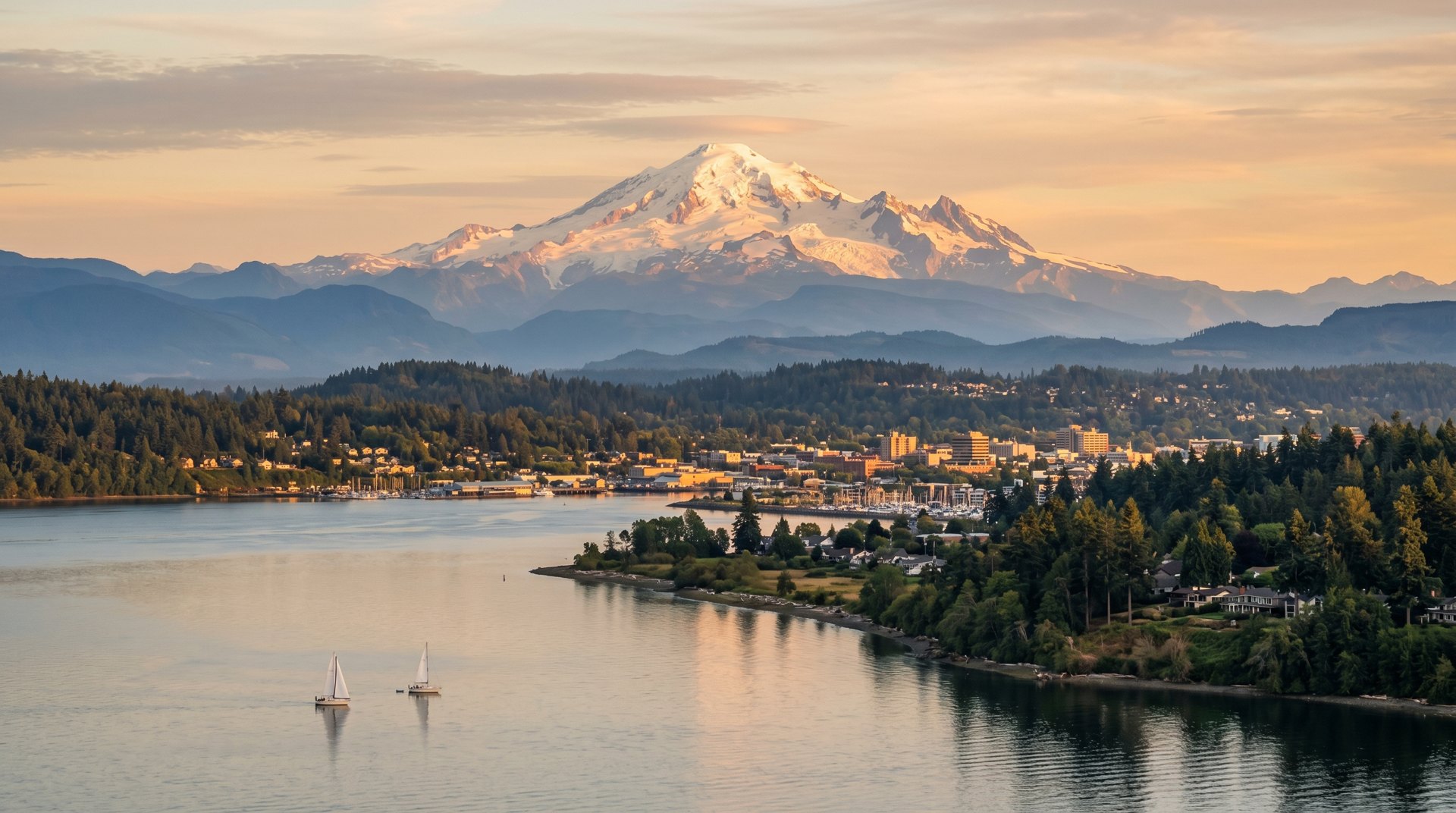
Summers here are exceptional. July highs average 73°F. You hike, bike, kayak, and eat outside without the logistics of avoiding midday heat. You sleep with the windows open. The outdoor season runs May through October with almost no weather-related limitations. Mt. Baker (10,781 feet) is 60 miles east. Chuckanut Drive hugs sandstone bluffs above the bay. Whatcom Falls Park is a 5-minute drive from downtown. The physical beauty of Bellingham in summer is genuinely different from anything Phoenix offers — not better or worse aesthetically, but green and water-oriented in a way that’s a complete contrast.
What you give up:
Nine months of guaranteed sunshine. Outdoor pool culture. The desert color palette — those sunsets, the saguaro silhouettes, the clean dry air. Year-round biking weather. The ability to sit outside on a December evening in a T-shirt.
The gray season:
November is the tipping point. Days shorten fast, rain arrives, and the mountain (Baker) disappears behind clouds for weeks. December through February averages 8–10 days of direct sun across the three months combined. Phoenix transplants who struggle in Bellingham almost all identify February as the hardest month — six weeks of unbroken gray with no end in sight.
My standing recommendation: if you’ve never experienced a Pacific Northwest winter, visit Bellingham in November or February before you buy. Almost everyone loves it in July. The question is whether you’d thrive — or at least adapt — in February. The transplants who do best tend to have one of three things: a warm trip south scheduled for January, a structured winter activity (skiing Baker, a yoga class, a volunteer commitment), or genuine introvert tendencies that find the gray cozy rather than oppressive.
One more climate note specific to Phoenix: many transplants find the first winter rain genuinely delightful. After years of 7-inch annual rainfall, the sound of rain on a roof feels novel and comforting. That honeymoon with the rain usually lasts one full winter. The second winter is the real test.
Why people leave Phoenix
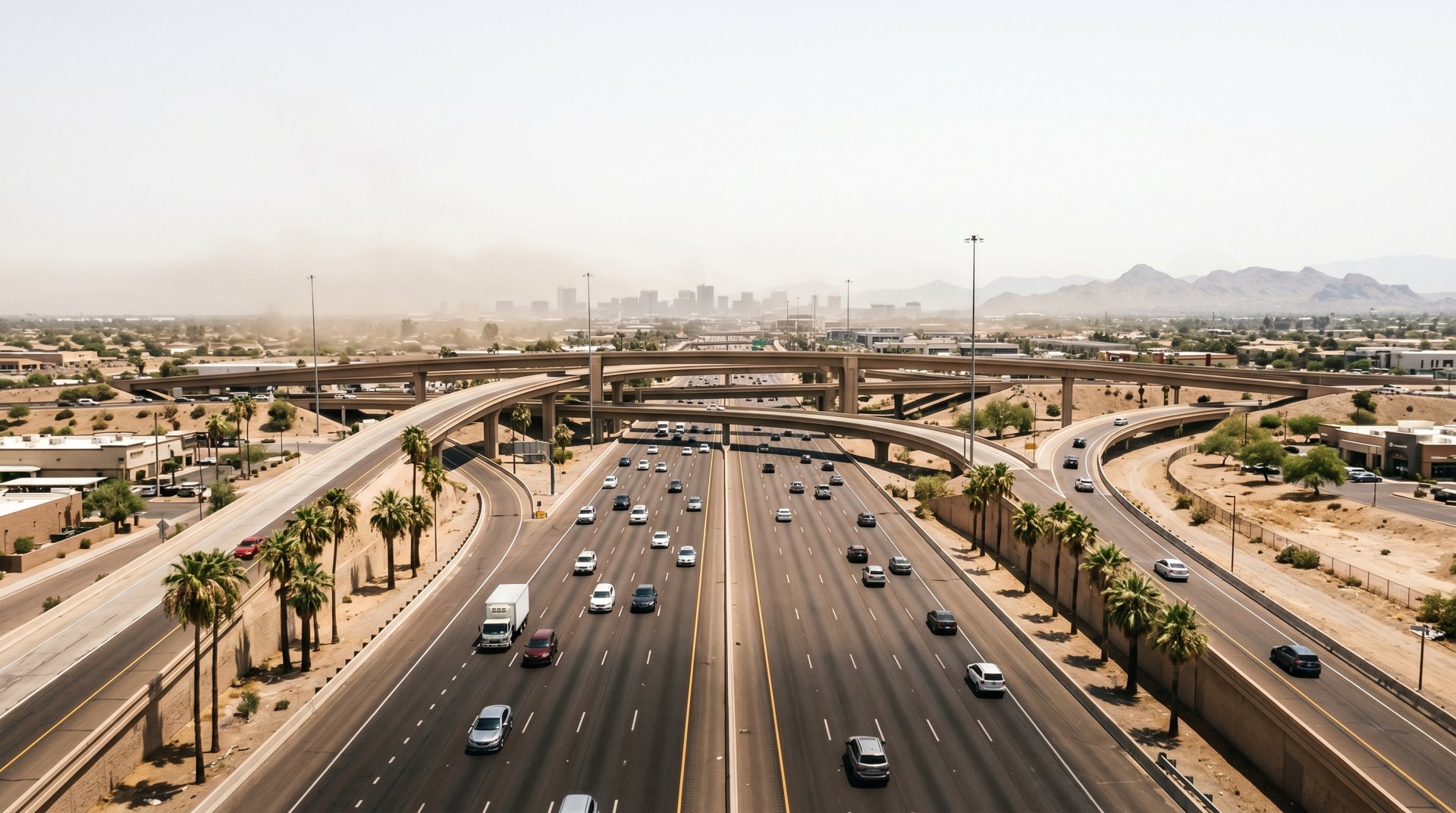
The climate trajectory is the story that ties everything together. Phoenix didn’t always feel unlivable in summer. Longtime residents describe a tipping point — somewhere around 2018–2022 — where the summers changed from “hot but manageable” to “genuinely dangerous.”
The heat: 2025 was Phoenix’s second-hottest year on record. The city logged 122 days above 100°F. Twenty-three nights never dropped below 90°F — a full night with no relief. The “urban heat island” effect in a metro of 5 million people means nighttime lows stay elevated even when the surrounding desert cools slightly. Outdoor workers face real mortality risk in July. Elderly residents face real mortality risk. The phrase “you just stay inside” — which Phoenix residents say casually — represents a genuine 4-month sentence of climate-controlled indoor living.
The water: The Colorado River compact was negotiated in 1922, based on flow estimates that overestimated the river’s volume. A century of over-allocation, agricultural use, and climate-driven drought has produced a crisis. Lake Powell hit 24% full and Lake Mead 32% in spring 2026. Arizona is already taking CAP shortage cuts. Phoenix has announced plans for tougher conservation measures. The city has worked hard to diversify its water supply — Salt/Verde river water, reclaimed water, groundwater banking — and Phoenix is genuinely better positioned than many AZ cities. But the long-term trajectory is real, and buyers in their 40s and 50s are doing 30-year math on water supply. Bellingham’s watershed — rain-fed, mountain snowpack — doesn’t generate the same anxiety.
The density and sprawl: Phoenix metro has grown into a massive car-dependent spread. Traffic on the I-10, I-17, and 202 during peak hours is genuinely bad. The built environment of most suburbs — commercial strips, wide arterials, few walkable cores — grates on residents over time. Buyers leaving Phoenix often name walkability and human-scale neighborhoods as things they’re actively seeking, not just passively hoping for.
The dust storms and monsoon chaos: Haboobs (wall-of-dust storms reaching 5,000 feet) roll through the metro one to several times per summer. Monsoon season brings flash flooding, downed trees, and power outages. These aren’t catastrophic risks, but they’re real annual weather events that add stress.
Air quality: Phoenix sits in a valley and traps particulate matter. Summer wildfire smoke from California, Utah, and Arizona’s own forests arrives August–September most years. Days-long smoke events with PM2.5 in the unhealthy range are now routine. Bellingham has smoke too — typically 1–3 weeks per summer from BC and eastern WA fires — but the baseline air quality is dramatically cleaner.
Commute reality — can you still work?
If you’re moving with a remote job, the commute question is simple: Bellingham has fast, reliable fiber internet (Ziply Fiber and Comcast both serve the city at gigabit speeds). Zoom and Slack work here. Co-working spaces like the Bellingham Business Accelerator and private offices in the Barkley neighborhood give you separation from home.
If your work requires regular Phoenix visits, here’s the math: Phoenix Sky Harbor (PHX) is a major hub. Bellingham International (BLI) has a handful of direct flights — primarily to SFO, LAX, and LAS via Alaska and United — but no direct PHX route. The standard travel pattern is drive to SEA (1 hour 15 minutes), connect to PHX (2 hours 55 minutes total flight), total door-to-gate time roughly 4–5 hours. Monthly Phoenix visits are genuinely manageable on this path. Weekly visits are a grind.
Seattle-Tacoma (SEA) is your operational airport. From Bellingham, it’s 90 miles and 75–90 minutes of driving (I-5, straight shot), longer during peak Seattle commute hours. The Bellingham Airporter Shuttle runs multiple daily trips to SEA for around $40 one-way if you’d rather not drive and park.
SEA has direct service to PHX multiple times daily (Alaska, Southwest, American) at roughly $120–$250 round trip depending on advance purchase. For quarterly visits, SEA works well. For monthly, budget $150 per trip plus parking or shuttle.
For fully remote workers, the commute question essentially dissolves. Bellingham has everything you need day-to-day and SEA for the occasional trip.
One specific angle for Phoenix retirees: if your adult children are in Phoenix, the SEA-PHX flight is easy — a 2.5-hour non-stop that costs less than most domestic hops. Grandkids can fly up to Bellingham on the same routes. The physical distance is manageable.
Buying a home here without flying up six times
About a third of my Phoenix buyers close on a Bellingham home after one in-person trip. Here’s how it works:
Phase 1: Remote prep (weeks 1–4) We start with a 30-minute discovery call — your situation, timeline, must-haves (single-level? yard? walkability? water view?), absolute limits. I set up a live NWMLS search with daily alerts tuned to your criteria. You build familiarity with neighborhoods through listing photos, street view, and my video walkthroughs of active inventory.
Phase 2: Virtual showings When something looks strong, I walk it on FaceTime or Zoom while you’re home in Phoenix. I’ll open every closet, check the crawl space access, walk the lot line, and tell you what the listing photos aren’t showing. Most buyers eliminate 60–70% of their shortlist through virtual showings before ever booking a flight.
Phase 3: The trip — 2 days, 5–7 homes One structured Bellingham trip. I schedule your finalists plus a few neighborhood walks so you see the texture of each area. Most buyers either find their home on this trip or narrow to 1–2 that we monitor closely after.
Phase 4: Offer and inspection remotely Washington offers use DocuSign. Earnest money wires the same day. We include a standard inspection contingency (typically 10 days). I coordinate the inspector and walk the inspection with them while streaming to you on FaceTime. You review the report, we negotiate repairs or credits, you sign electronically.
Phase 5: Closing Title and escrow is handled by Chicago Title or Whatcom Land Title (both have strong Bellingham offices). Most out-of-state closings use a mobile notary — they come to you anywhere in Phoenix for the signing appointment. You wire funds, they record the deed, you get keys same day. Entire process is manageable from Arizona.
Coordinating the AZ sale: If you’re selling your Phoenix home simultaneously, the standard approach is to list in Phoenix 45–60 days before your target Bellingham close. We use a simultaneous-close contingency or a short seller-possession period on the AZ side so you’re not carrying two mortgages. For Phoenix sellers moving to a higher price point in Bellingham, a bridge loan is sometimes needed to cover the gap between the down payment need and the AZ sale proceeds timing — I have lenders who do this routinely.
One note specific to Arizona: unlike California, Arizona doesn’t impose aggressive departure taxes or franchise tax investigations when you move. You file a part-year AZ return for the year you leave (reporting income earned while an AZ resident), establish WA residency via driver’s license and voter registration, and you’re done. Much cleaner than CA-to-WA moves.
Schools — the comparison families ask about
Families moving from Phoenix metro have generally experienced large district schools — Scottsdale Unified, Mesa Unified, Chandler Unified — all respectable districts with strong honors and AP programs. Bellingham’s school options are smaller in scale but competitive in outcome.
Bellingham Public Schools serves the city proper. Sehome High School and Bellingham High School both have strong AP offerings and above-average graduation rates. The district has been working on equity and student support gaps in recent years — it’s improving but not without the standard urban-district challenges.
Ferndale School District (10 miles north) consistently scores higher on state assessments, has newer facilities, and draws families who want suburban-scale schools with less city-district politics. A lot of Phoenix transplant families end up in Ferndale specifically.
Lynden School District (15 miles north) is academically strong with a tight-knit community feel and high graduation rates. More conservative socially than Bellingham proper, which suits some Phoenix families and not others.
Whatcom County private options: Bellingham Christian School, Meridian School District (rural, mid-county), and homeschool networks are all active.
For families with college-bound teenagers: Western Washington University sits directly in Bellingham — a 16,000-student public university with strong programs in business, education, sciences, and the Fairhaven College interdisciplinary program. WWU’s in-state tuition gives WA residents a legitimate cost advantage.
The honest comparison to Phoenix private schools: if you’re pulling kids from BASIS or other high-performing AZ charter schools, Bellingham’s public schools will feel smaller and less test-score-focused. Ferndale and Lynden are the closest comparables. Most families who do the move report their kids adjusted better than expected.
Five Bellingham neighborhoods Phoenix buyers tend to land in

Fairhaven is the first neighborhood I show most Phoenix transplants who want walkability and character. The Victorian commercial core — with Village Books, Skylark’s Café, and a string of restaurants — is genuinely walkable. Single-family homes range from $600,000 to $1.2M+ depending on size and view. Fairhaven has a village-within-a-city feel that nothing in the Phoenix suburbs replicates. Retirees and empty nesters from Phoenix gravitate here specifically. Link: /neighborhoods/fairhaven/
Edgemoor sits on the west side, adjacent to Fairhaven, with larger lots, more tree canopy, and homes that tend toward the $750,000–$1.4M range. It’s quieter, more residential, and attractive to Scottsdale-tier buyers who want space and privacy without the exurban isolation. Views of Bellingham Bay show up on the higher streets. Link: /neighborhoods/edgemoor/
South Hill is the neighborhood I point to for Phoenix buyers watching their budget. Homes in the $500,000–$700,000 range, closer to I-5, with quick access to Bellingham’s commercial corridor and an easy commute to Ferndale for families enrolling kids in Ferndale schools. Less architectural character than Fairhaven, more practical — newer construction, level lots. Link: /neighborhoods/south-hill/
Barkley has emerged as Bellingham’s professional neighborhood — mid-rise mixed-use, easy parking, the Barkley Village commercial cluster with restaurants, medical offices, and fitness studios. Homes and condos in the $550,000–$850,000 range. Remote workers who want a walkable lunch break and easy co-working access often land here. The neighborhood’s newer build quality also appeals to buyers leaving newer Phoenix construction who don’t want to manage a 1950s Bellingham craftsman’s deferred maintenance. Link: /neighborhoods/barkley/
Columbia is the neighborhood I recommend to Phoenix buyers who mention the word “community.” The layout concentrates density around a walkable core with smaller lots, neighborhood events, a strong neighbor-network culture, and prices that run $520,000–$720,000 for SFR. It has a Pacific Northwest eco-consciousness ethos — community gardens, bike infrastructure, political yard signs — that some Phoenix transplants find energizing and others find a bit much. Worth a walk-through to see if the vibe matches yours. Link: /neighborhoods/columbia/
The lifestyle shift — what changes
The pace is different. Phoenix at its densest — Scottsdale’s Old Town, Tempe Town Lake, downtown Mesa — has an energy that Bellingham simply doesn’t match. Bellingham is a city of 95,000 people. The downtown restaurant scene is good but not vast. There’s no Phoenix Suns, no Cardinals, no Coyotes. Concerts come through but you’re not walking to a major venue on a Tuesday.
What you gain is a different kind of life. The outdoor culture here is intense and year-round-accessible in a way Phoenix’s isn’t — because the “outdoor season” in Phoenix is compressed to October–April, while Bellingham’s is genuinely 12 months (even in January, people are running Chuckanut trails in the rain). The Saturday morning in Bellingham looks like: farmer’s market, Whatcom Falls hike, lunch at a waterfront spot, home. It’s a life scaled to a human pace.
The grocery stores are good (Haggen, Fred Meyer, Trader Joe’s, natural-foods co-op). Healthcare is strong — PeaceHealth St. Joseph is a full-service regional medical center. The arts scene is active for a city this size: Mt. Baker Theatre brings touring productions, the Bellingham Symphony plays a full season, Pickford Cinema runs independent and international film. If you were content in a mid-sized Phoenix suburb rather than the urban core, Bellingham’s amenity level will feel complete. If you need a major metro’s energy regularly, you’ll be driving to Seattle.
The rain itself changes daily rhythms. You carry a good rain jacket instead of sunscreen. You plan outdoor events around “partly cloudy” rather than “hot.” You stop worrying about your car’s paint fading from UV. Small adjustments, but they accumulate into a genuinely different daily texture.
Frequently asked
Is the Phoenix → Bellingham move tax-positive after carrying costs?
For most households earning above $100,000, yes — the 2.5% Arizona income tax elimination more than offsets the slightly higher Bellingham property tax rate and gas prices. A household at $200,000 saves roughly $5,000/year in state income tax; add $1,500–$2,000 in eliminated cooling costs, and the annual operating-cost advantage is $6,000–$7,000 even before any home equity appreciation. Retirees see a smaller income-tax win (AZ exempts Social Security; WA exempts everything), but the cooling-cost savings and water-security narrative still favor the move.
What’s the real winter like compared to Phoenix?
Phoenix January averages 67°F highs and 44°F lows — effectively spring weather. Bellingham January averages 46°F highs and 35°F lows, with persistent cloud cover and rain. It doesn’t snow much in the city (a few events per year, rarely sticking), but the gray and damp are relentless from November through March. It’s not dramatically cold — you won’t need a heavy parka most days — but it’s a complete psychological contrast to Arizona. I strongly recommend a February visit before committing to the move.
Can I buy a Bellingham home without flying up more than once?
Yes, and about a third of my Phoenix buyers do. Virtual showings handle the heavy lifting; one structured 2-day trip covers final candidates; inspection and closing all execute remotely via DocuSign and mobile notary. The process is proven and clean — Washington real estate contracts are well-structured for remote buyers.
Does Bellingham feel like a college town?
Somewhat, yes. Western Washington University’s 16,000 students put a college-town energy into certain neighborhoods — a rotation of good cheap restaurants, active bar scene in the Barkley-adjacent zones, strong book culture, bike infrastructure, political consciousness. It skews younger and more progressive than most Phoenix suburbs. For buyers who find that appealing — and many Phoenix transplants do — it adds energy. For buyers who want pure suburban quiet, the outer neighborhoods (Edgemoor, parts of South Hill) have less of it.
What’s the catch?
Honestly: housing prices are high relative to Phoenix mid-tier, and the gray season is long. If you’re expecting to land in a comparably priced home without adjusting your budget or target, you’ll be disappointed. And if you’ve never spent a winter at 48°N under marine overcast, you should experience it before betting your housing equity on it. Those two things acknowledged, buyers who do their homework and visit in winter before buying tend to be very happy long-term.
How hard is it to get flights back to Phoenix for visits?
Easy from SEA (Seattle-Tacoma), which is 90 minutes south on I-5. Alaska, Southwest, and American all run multiple daily PHX–SEA non-stops. Drive SEA, fly PHX, door-to-destination is about 4–5 hours total. The Bellingham Airporter handles the SEA ground leg if you’d rather skip parking. BLI (Bellingham’s local airport) doesn’t serve PHX directly — you need SEA for that route.
What about the snowbird play — keep a Phoenix base for winter?
It works well and several of my clients do it. Bellingham May–October (summers are glorious), Phoenix November–April (warmth and family access). The operational challenge is managing two properties; the financial math requires running the numbers on two carrying costs vs. the lifestyle value. For buyers with the equity from a Scottsdale home, this is genuinely achievable.
Is Bellingham getting crowded with PNW transplants?
It’s growing. Bellingham has absorbed meaningful in-migration from Seattle (equity-driven), California (same), and increasingly from Southwest metros. The growth is visible in housing prices and new commercial development. It hasn’t yet reached Bend, Oregon levels of transplant saturation, but prices are moving, and the Bellingham that buyers bought into in 2018 is different from today’s market.
Thinking about Bellingham?
Tell me where in Phoenix you’re coming from, your budget, and how you work, and I’ll send two or three neighborhoods that fit plus what’s active. If you have a place to sell first, a home valuation is the place to start.