

SEATTLE → BELLINGHAM · RELOCATION GUIDE
From Seattle to Bellingham.
The honest math.
Same state, same tax structure, 90 miles north — and roughly $300,000 less in housing cost.
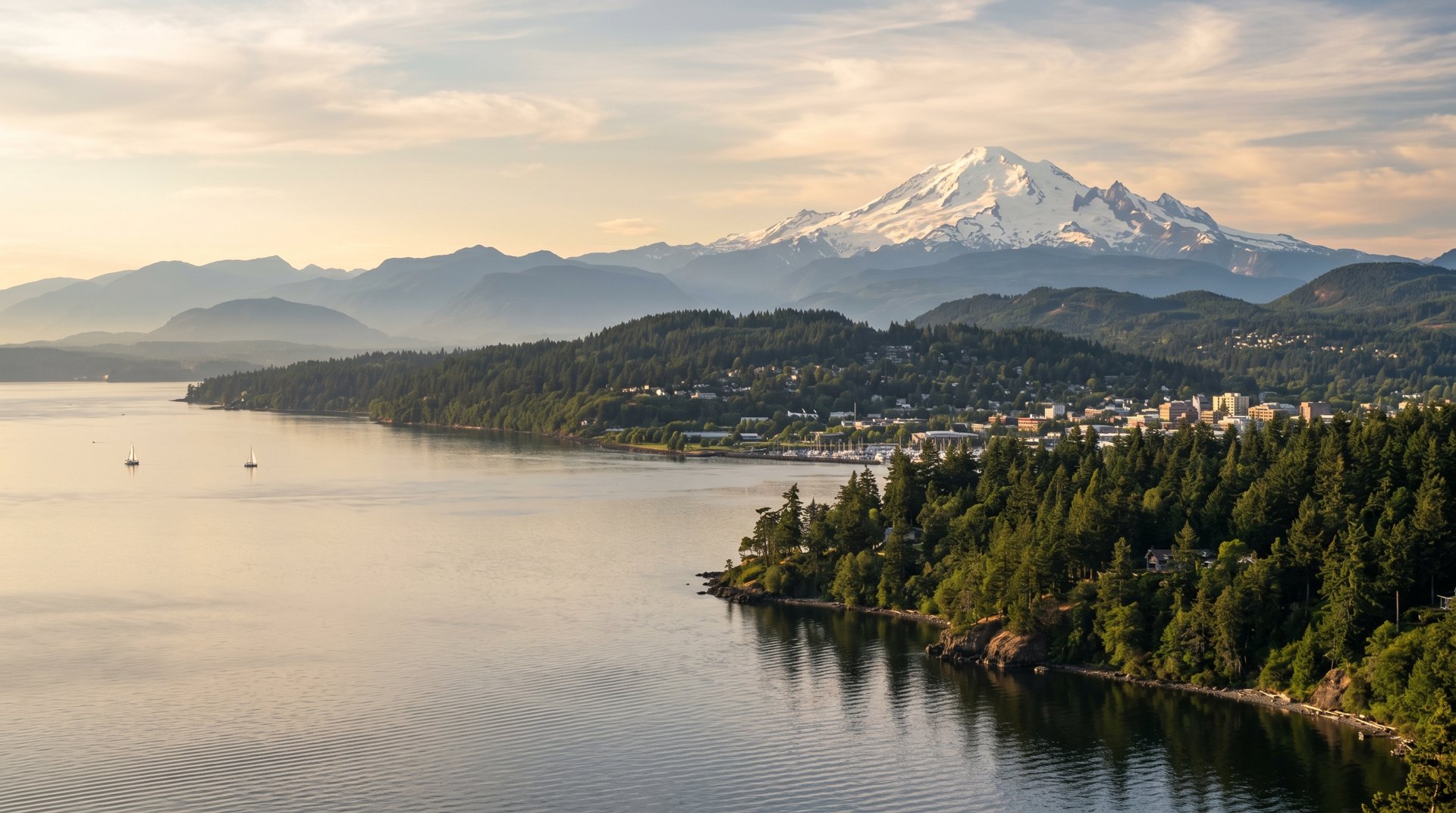
The Seattle-to-Bellingham conversation is one I have constantly — and it’s different from every other relocation I handle. You’re not crossing a state line, you’re not changing your tax bracket, you’re not giving up your Washington drivers license or figuring out a new DMV. You’re staying in the same state, on the same stretch of I-5, staying on NWMLS. What you’re actually doing is trading the 7th-most-congested metro in the country for a small Pacific Northwest city 90 miles north — and in most cases, trading a $950,000 to $1.1 million housing payment for something in the $650,000 to $750,000 range. I’ve walked dozens of Seattle-area buyers through this move. Here is the full, honest picture.
The equity reset, in actual numbers

King County single-family homes hit a median of $975,000 in 2025, confirmed by NWMLS year-end data. That’s the county-wide number — Bellevue and Kirkland skew higher, Burien and SeaTac pull it down. If you’re in Eastside tech suburbs, your home is likely $1.1M to $1.8M. If you’re in a walkable Seattle neighborhood like Capitol Hill or Ballard, you’re looking at $800K to $1.1M.
Bellingham’s median sits around $710,000 as of early 2026, based on Redfin and Cascadia Daily News data. The spread is meaningful: a $975,000 Seattle home sells for roughly $916,500 after 6% in selling costs. A Bellingham purchase at $650,000 with $10,000 in closing costs lands you at $660,000 all-in. In that scenario, you’re freeing up approximately $256,500 in equity — cash you can deploy toward early retirement, a paid-off home, a vacation rental at Birch Bay, or a business.
Sellers from the Eastside — Bellevue, Redmond, Kirkland — often have $400,000 to $800,000+ more flexibility. That’s a different conversation. Some of those buyers are purchasing Bellingham homes outright.
Here’s the direct comparison:
| Seattle / King County | Bellingham / Whatcom | What’s different | |
|---|---|---|---|
| Median single-family price | ~$975,000 | ~$710,000 | ~$325K less in Bellingham |
| Property tax effective rate | ~0.93–0.99% | ~0.81–0.92% | Slightly lower in Whatcom |
| Annual property tax (median home) | ~$9,000–$9,700 | ~$5,300–$6,000 | $3,000–$4,000 less/yr |
| State income tax | 0% | 0% | No change — same state |
| Sales tax | 10.55% (Seattle, 2026) | 9.1% (Bellingham, 2026) | ~1.4 points cheaper |
| Typical peak-hour commute | Rush hour adds 45–90 min/day | 10–20 min across city | Major lifestyle difference |
| Gas (regular, March 2026) | ~$5.53/gallon | ~$5.20–5.40/gallon | Both well above US average |
| Groceries | ~10–11% above US average | ~5–7% above US average | Modest savings |
| Overall cost of living index | ~44% above US average | ~18–22% above US average | Material difference |
One critical note for Seattle-to-Bellingham moves: there is no state income tax flip. Washington has 0% state income tax and so does Bellingham. No one is saving on income tax here — that’s a California story. The real financial win is housing price arbitrage and a modest drop in sales tax. If your financial case depends on tax savings, be honest that the savings are property tax (meaningful over time) and sales tax (modest). The equity unlock on the home is the real number.
Cost of living, line by line
What gets cheaper:
Housing is the headline. A 3-bedroom, 2-bath home with a yard and a two-car garage costs $600K to $750K in Bellingham. The comparable Seattle home — if you can find one with a yard — starts at $900K to $1.1M. That gap shows up every single month in your mortgage payment. On a 30-year at current rates, the difference between a $700K and $975K loan is roughly $900 to $1,100 per month.
Sales tax drops from Seattle’s 10.55% to Bellingham’s 9.1%. On a $5,000 monthly spend, that’s about $72/month back in your pocket — not the story, but real.
Eating out is meaningfully less expensive. Bellingham has good food, not Seattle-scale variety. A dinner for two at a mid-range Bellingham restaurant is $70 to $100. A comparable Seattle dinner is $100 to $140. You eat out less but spend less when you do.
Services — haircuts, dentistry, basic home services — run 15 to 20% less than Seattle rates. There’s less price compression from competing with high-earning tech workers.
Property taxes. King County’s effective rate (~0.93–0.99%) combined with Seattle’s additional local levies (Sound Transit, school levies, open space, etc.) means Seattle homeowners consistently pay 5 to 15% more in total property taxes than Whatcom County homeowners on equivalent assessed values.
What stays the same or gets more expensive:
Gas. Both markets sit well above the national average. Seattle averaged around $5.53/gallon in March 2026; Bellingham typically runs $5.20 to $5.40. The Washington carbon market keeps both expensive.
Utilities. Seattle has relatively cheap electricity via City Light’s hydro rates. Bellingham runs on PSE (Puget Sound Energy) which is moderately more expensive for natural gas heat. Electric rates are comparable. Budget $180 to $250/month for a typical home.
Internet. Same providers, similar pricing. Bellingham has Comcast/Xfinity and some fiber options. Not worse than Seattle.
Professional services (specialty). Seattle has a deeper market for specialized services — certain medical specialists, certain contractors, certain professionals. Expect a longer wait or a Seattle drive for niche needs.
The climate — the honest part

I am not going to tell you Bellingham has better weather than Seattle. That would be a lie.
Seattle averages 152 sunny days per year and about 39 inches of annual precipitation, with 226 overcast or cloudy days. Bellingham is modestly worse: roughly 230+ cloudy days, about 36 to 42 inches of precipitation, and fewer annual sunshine hours. The National Oceanic and Atmospheric Administration data consistently shows Bellingham as one of the cloudiest cities in the contiguous US.
The winter pattern is almost identical to Seattle’s: long stretches of low gray cloud, drizzle, short days. November through February is dark and wet in both cities. If you’ve already survived 5 Seattle winters and the pattern is wearing on you, I want to be direct: moving 90 miles north does not solve this. It may be slightly more pronounced.
What is different is the summer. Bellingham summers are genuinely extraordinary. July average high: 72°F, low overcast. The gray lifts in June and doesn’t return until October. You get four solid months of Pacific Northwest summer — Bellingham Bay at sunset, Galbraith Mountain trail rides, kayaking the San Juans, outdoor dining until 9 PM. The contrast between a Bellingham February and a Bellingham July is about as stark as weather gets anywhere.
What the climate win is NOT: sunshine totals. What the climate win IS: escaping Seattle’s density, noise, and stress while living in the same weather envelope you already know. The gray isn’t new to you. The quiet is.
For comparison — Seattle’s January low averages about 37°F, July high averages 77°F. Bellingham’s January low is around 35°F, July high around 72°F. Marginally cooler year-round, otherwise nearly identical pattern.
My honest advice: come in November. Book a long weekend, walk around Fairhaven in the rain, drive past South Hill in the gray, and ask yourself if you like it. If the November Bellingham feels quiet and livable rather than oppressive, you’ll love it. If November makes you want to flee, consider a sunnier destination.
Why people leave Seattle
The push factors I hear most from Seattle clients:
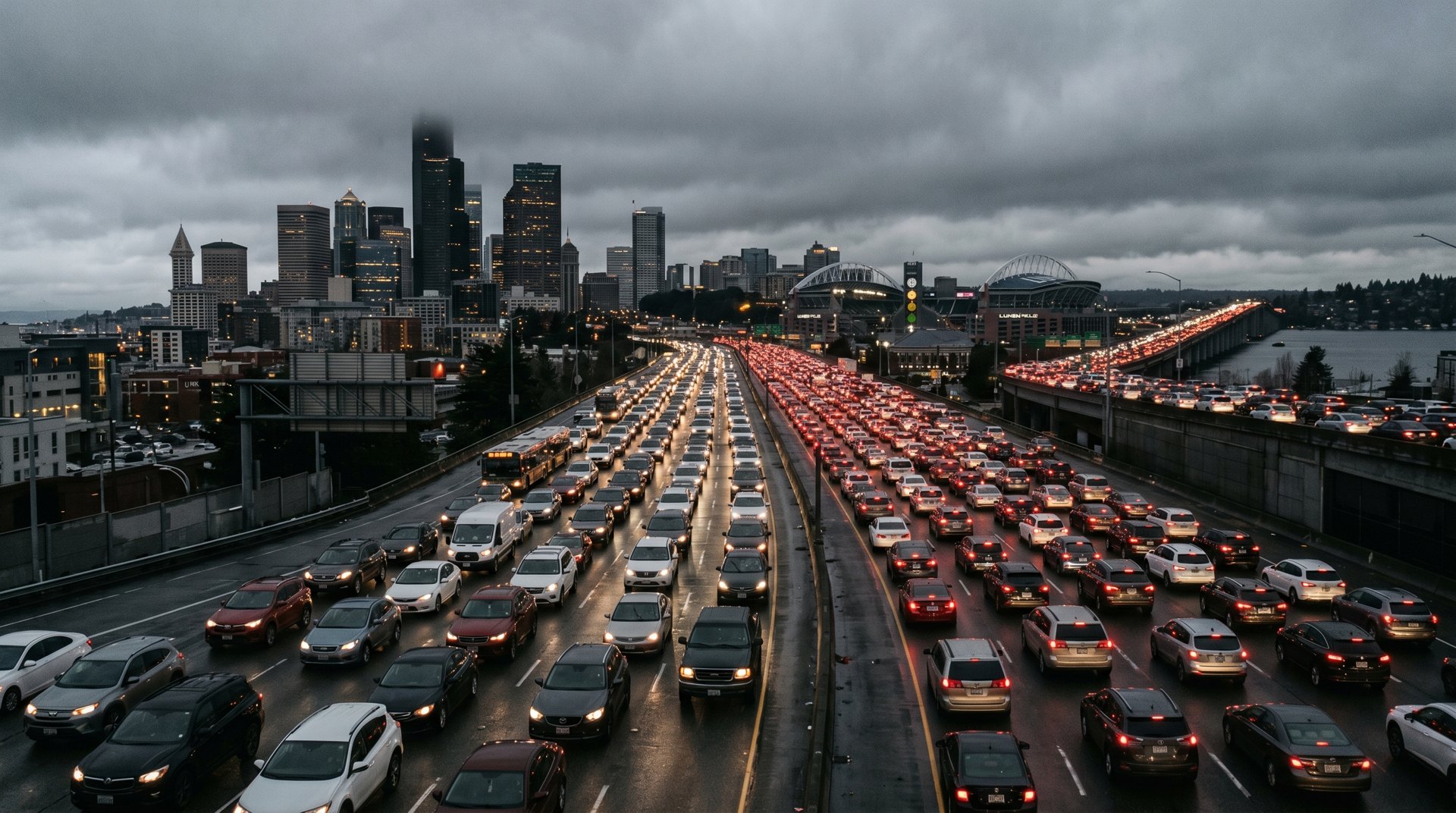
Traffic and commute exhaustion. Seattle ranked 7th among U.S. cities for traffic congestion in 2025 (TomTom Index), with drivers losing an average of 66 hours per year to rush-hour congestion — up from the prior year. The picture is specific: SR-99 backing up through South Lake Union at 4:45 PM. The 520 bridge at a standstill by 5:15. I-5 through downtown turning into a parking lot on any Friday after 3 PM. Buyers from Bellevue tell me about 45-minute commutes that turned into 90-minute daily slogs. That’s not a weather problem — that’s an infrastructure and density problem that I-5 North solves permanently.
Housing cost exhaustion. A generation of Seattle-area workers — including very well-paid tech workers — have watched their salaries be partially consumed by housing. When a software engineer making $180K is still renting because the homes they like cost $1.2M, something is off. I see a meaningful number of tech workers leave Seattle not because they can’t afford it, but because the price-for-life-quality ratio stopped making sense.
Scale and anonymity getting old. Seattle is a city of 750,000+ in a metro of 4 million. Restaurants you love close when they lose their lease. Your neighborhood block changes feel. You stop knowing your neighbors because the churn is high. Some buyers hit 35 or 40, realize they’ve lived in Seattle for a decade and still feel like residents of a temporary city, and decide they want to actually know where they live.
Density and unhoused population visibility. This is a real push factor for families I work with. The open drug use and visible homelessness in certain Seattle neighborhoods — especially Pioneer Square, parts of Capitol Hill, Third Avenue downtown — creates friction for parents with young kids, or people who’ve simply tired of navigating that daily. I’m not editorializing about policy; I’m reporting what buyers tell me.
The desire to actually use the outdoors. Seattle is surrounded by spectacular nature — the Olympics, Rainier, the Cascades. But getting to it involves traffic. Mt. Rainier is 2+ hours from Seattle. The Olympics require a ferry plus 90 minutes. In Bellingham, Galbraith Mountain is inside city limits. Mt. Baker is 60 miles east. The San Juans are a 30-minute ferry. The access compression is real.
Commute reality — can you still work?
The first question every Seattle buyer asks. Here’s the accurate version:
Driving I-5 south: 90 miles, 90 minutes in perfect conditions, closer to 2 hours in typical conditions, 2.5+ hours on bad days (Fridays, holiday weekends, summer). The stretch through Marysville and Everett is reliably the worst section. If you’re heading to a Seattle office, this is a significant daily undertaking.
Amtrak Cascades: Bellingham’s Fairhaven Station has two southbound departures per day to Seattle’s King Street Station. Travel time is approximately 1 hour 55 minutes to 2 hours 15 minutes. The schedule is limited — if you miss your train, you’re in the car. But for 1 or 2 days per week in Seattle, Amtrak is genuinely comfortable: you can work on the train, skip parking, and arrive downtown without a car.
Flying SEA: Seattle-Tacoma is 100 miles south (~2 hour drive). For business travel, this is fine. For daily commuting it’s impractical. Bellingham International (BLI) has Alaska and Allegiant service but no regular Seattle route — SEA is your primary hub.
The honest conclusion: This move works for remote workers, for people who go to Seattle 1 to 2 days per week and can do Amtrak, for self-employed people, and for retirees. It does not work for 3-to-5-day Seattle office requirements. If your employer is requiring 3+ days per week in Seattle, look at Snohomish County (Everett, Marysville) instead — you’ll cut the commute to 45 to 60 minutes and still get meaningful price relief.
Remote work is the dominant pattern in my Seattle-to-Bellingham buyer pool. The workers who locked in remote agreements in 2020 to 2022 and never went back — they kept the Seattle salary and moved the life north. That playbook still works for the right job situation.
Buying a home here without flying up six times
Seattle’s proximity actually simplifies the buying process compared to out-of-state buyers — but it doesn’t eliminate the process.
How the search typically runs:
I set up NWMLS listing alerts immediately. NWMLS covers both King and Whatcom counties, so Seattle buyers are often already familiar with the platform and what they want. I send daily digests and we talk through anything that warrants attention.
For virtual showings: I do video walkthroughs via FaceTime or recorded video for every listed property. Because most Seattle buyers are 90 minutes away (not 5 hours), most choose to do at least one in-person scouting trip early in the process — drive multiple neighborhoods, get a feel for the commute from wherever in Bellingham you’re considering.
The inspection trip: Once you’re under contract, plan 1 full day in Bellingham for your inspection. I work with several excellent local inspectors (InterNACHI-certified, $400 to $500 for a full SFR). You can combine this with a second neighborhood walk and a conversation with a local lender if you haven’t already arranged financing.
Washington earnest money is typically 1% to 3% of purchase price, due within 2 business days of mutual acceptance. I handle the paperwork and work with Chicago Title in Bellingham (my go-to: Leah Richardson at the Bellingham office). They’re experienced with Seattle buyers closing remotely and can accommodate electronic notarization for most documents.
Timing with your Seattle sale: The most common structure I’ve seen is: list the Seattle/King County home, go under contract, then activate your Bellingham search with a contingency or a timing-coordinated close. If the Seattle market cooperates (and King County inventory has tightened meaningfully in certain pockets), you can often align both closings within 30 days of each other. I’ve coordinated several dual closes where the Seattle proceeds fund the Bellingham down payment the same day.
One thing Seattle buyers often underestimate: Bellingham’s market moves faster than Seattle buyers expect. Desirable homes in Fairhaven, South Hill, or Edgemoor get multiple offers quickly. The assumption that “it’s smaller than Seattle, so I have more time” is sometimes wrong. When a well-priced South Hill home with bay views hits the market, it typically goes in 7 to 14 days.
Schools — the comparison families ask about
Seattle families consistently ask this, and the honest comparison is: Bellingham Public Schools is smaller, more stable, and comparably academic — but not categorically better or worse than Seattle Public Schools across the board.
By the numbers: Bellingham Public Schools (BPS) serves approximately 11,000 students across 20+ schools. Seattle Public Schools (SPS) serves around 50,000. BPS has generally lower class sizes, more manageable bureaucracy, and has avoided the high-profile controversies that have affected SPS in recent years.
For families coming from Seattle: The most consistent feedback I get is that BPS feels calmer — less political noise in the parent community, more direct access to teachers and principals, and better visibility into what’s actually happening in your child’s classroom.
Western Washington University (WWU) is the major anchor — about 16,000 students, a respected public liberal arts and sciences university. Having a college-town environment is a net positive for K-12 schools in terms of educational culture, extracurricular options, and the intellectual environment families often want.
Other Whatcom County districts: Ferndale is strong and family-oriented; Lynden is high-performing academically and more culturally conservative; Meridian and Blaine are smaller rural districts. Many Seattle families settle specifically for BPS or Ferndale, with Lynden as an option for families whose values align.
Five Bellingham neighborhoods Seattle buyers tend to land in

After years of placing Seattle buyers, five areas come up over and over:
Fairhaven — Seattle’s Capitol Hill and Bellingham’s Fairhaven have the same energy: walkable, indie shops, coffee culture, old houses with character. The difference is Fairhaven fits in about 12 square blocks rather than 200. It’s tight, it’s beautiful, and it’s the first place I take buyers from Capitol Hill or the Central District who want walkability above everything. Expect $750K to $1.1M+ for single-family, with some condos and townhomes below that. Links to /neighborhoods/fairhaven/.
Edgemoor — Buyers from Queen Anne, Magnolia, or the Bellevue waterfront neighborhoods gravitate here. Edgemoor sits between Fairhaven and South Hill along Bellingham Bay, protected view corridors, established landscaping, the kind of neighborhood where people stay 20 years. Median sales around $1.2M. Limited turnover. /neighborhoods/edgemoor/.
South Hill — Direct bay and San Juan Island views, quick access to Taylor Dock and Boulevard Park, quieter than Fairhaven. This is where I send buyers from West Seattle and Magnolia who want the view and the quiet walk to the water, without the full Fairhaven premium or the Edgemoor price point. Strong $800K to $1.2M range. /neighborhoods/south-hill/.
Sehome / Whatcom Falls area — Central Bellingham, walkable to Western Washington University, close to Whatcom Falls Park (one of the genuinely underrated urban parks in Washington State). This neighborhood pulls buyers from Wallingford, Green Lake, and the U-District who want a college-town feel with trail access and neighborhood walkability. Prices are more moderate — $600K to $900K range — and the stock is a mix of older craftsman homes and 1970s builds. /neighborhoods/sehome/.
Barkley / Cordata — This is where I send buyers from Eastside suburbs — Redmond, Kirkland, Sammamish — who want newer construction, good school access, a two-car garage, and neighborhood amenities without the historic-house maintenance. Barkley Village has walkable shopping and dining; Cordata has newer builds closer to the freeway. Price range $550K to $800K. More inventory, less character than Fairhaven or South Hill, but practically excellent for families. /neighborhoods/barkley/.
The lifestyle shift — what changes
The change that catches Seattle buyers most off guard is how quiet Bellingham is at night.
After a year in Seattle, your baseline ambient sound level calibrates to: distant sirens, the low hum of traffic on a nearby arterial, bass from a bar two blocks over. In Bellingham residential neighborhoods, you hear nothing. Some buyers love this immediately. Some find it eerie for the first month.
The second shift is pace. Seattle runs at a specific speed — coffee shops fill before 7 AM, Whole Foods is a full-contact sport on Saturdays, everyone is perpetually rushed. Bellingham has fewer things competing for your attention. The food co-op is less crowded. Your dentist isn’t booked six months out. You stop getting jostled walking down the sidewalk.
Outdoor access intensifies. Galbraith Mountain’s trail system is literally inside Bellingham city limits — from most neighborhoods, you’re mountain biking or trail running in 10 minutes. Lake Padden and Lake Whatcom are swimming distance from downtown. The San Juan Islands are an hour by ferry. This is the lifestyle upgrade: not better weather, but shorter time from home to wilderness.
The social layer thins. Seattle has the depth of a major metro — niche social scenes, endless event calendars, a large pool of people who share any given interest. Bellingham has a genuinely warm social culture (college town, outdoor community, arts community) but at smaller scale. Buyers who hit the ground running, join things, and engage the local scene report finding their people quickly. Buyers who wait for community to come to them can take longer to feel connected.
Frequently asked
Is the Seattle to Bellingham move a tax win?
Partially. Since both cities are in Washington, there’s no state income tax change at all — WA has 0% and that doesn’t move. The real savings are: lower property tax effective rate (~0.81–0.92% in Whatcom vs ~0.93–0.99% in King County, plus Seattle’s additional local levies), and lower sales tax (9.1% Bellingham vs 10.55% Seattle as of 2026). On a $650,000 Bellingham home, you’re saving roughly $3,000 to $4,000 per year in property taxes versus a comparable King County home — not nothing, but the real win is housing price, not tax rate.
What’s the real winter like compared to Seattle?
Nearly identical, with Bellingham slightly worse. Both cities get 220 to 230+ overcast days per year, consistent November through February drizzle, and short dark days. Bellingham averages a January low of about 35°F versus Seattle’s 37°F — meaningfully the same. The difference is summer, which is genuinely spectacular in Bellingham. If Seattle winters are already grinding on you, I’d be honest: adding 90 miles north doesn’t fix it. The win is everything else about the move, not the gray sky count.
Can I buy remotely from Seattle — or do I need to be there in person?
Because you’re 90 minutes away, most Seattle buyers choose to visit in person more often than out-of-state buyers, and I’d encourage that. Plan 2 to 3 scouting visits: once to walk neighborhoods, once under contract for your inspection. I can handle everything else — alerts, video tours, offers, coordination with Chicago Title — remotely. Closings can be done electronically for most documents. The proximity actually makes this easier than any other relocation I handle.
Does Bellingham feel like a college town?
Yes, noticeably. WWU has 16,000 students in a city of 95,000. You feel it: the coffee shop culture, the outdoor community, the progressive political lean, the mix of age groups downtown. Most Seattle transplants find this a positive — the energy is there without the full Seattle-scale grind. If you actively don’t want to be around students and university culture, the Barkley/Cordata area is more suburban and buffered.
What’s the catch?
Professional opportunities. If you’re in tech, finance, biotech, healthcare administration, or any specialized high-income field that requires in-person professional density — Bellingham is thin. The people who make this move successfully are either remote workers keeping their existing role, business owners who can operate location-independently, retirees, or people specifically seeking a career shift to Bellingham’s actual economy (healthcare, education, trades, tourism, small business). Planners who think they’ll commute to Seattle 4 days a week and save money on housing almost never make it work for more than a year.
What happens with my Seattle home if I keep it as a rental?
King County rental demand is durable — Seattle has structural undersupply and strong renter demand. Many of my Seattle-to-Bellingham buyers keep the Seattle property as a rental for 1 to 3 years before deciding to sell. The tax implications (passive income, depreciation recapture on eventual sale, 1031 exchange options) are worth a conversation with your CPA before you close. I can connect you with a Seattle-market property manager if that’s the direction you want to go.
How long does the typical Seattle-to-Bellingham search take?
Most Seattle buyers actively searching take 2 to 4 months from initial alerts to close. The variable is how specific your neighborhood requirements are — Edgemoor and South Hill have lower inventory and slower turnover, so those buyers often wait longer. Buyers open to Barkley, Cordata, or Sehome tend to find homes faster. I typically suggest starting the NWMLS alerts 3 to 6 months before your target move date so you understand the market before you’re pressed by timing.
Thinking about Bellingham?
Tell me where in Seattle you’re coming from, your budget, and how you work, and I’ll send two or three neighborhoods that fit plus what’s active. If you have a place to sell first, a home valuation is the place to start.