
CALIFORNIA → BELLINGHAM · RELOCATION GUIDE
From California to Bellingham.
The honest math.
The equity reset, the tax flip, the climate trade-off — and what nobody tells you about the gray months.
Updated June 2026 · Genaro Shaffer · Bellwether Real Estate
If you sell a $1.5M Bay Area home and buy in Bellingham, you walk away with around $700K in real estate plus roughly $500K in cash, and your annual tax bill drops by about $80,000. That single sentence is the reason I get five California buyer calls a week. The math is real. But it’s not the whole story — and the parts nobody talks about are the parts that decide whether you’ll actually be happy here in year three. This is the honest version.
 San Juan Islands at golden hour” class=”wp-image-431″/>
The equity reset, in actual numbers
The median single-family home in Bellingham trades around $705K right now. The median in San Francisco is roughly $1.4M; the Bay Area composite hovers near $1.2M; Los Angeles city is around $950K. If you’ve owned in California through the last decade, you’re sitting on something between $300K and $1M+ of trapped equity. Sell here, buy in Whatcom County, and most of that equity comes out as cash.
The classic case I see: a couple sells a 1,400-square-foot 1960s ranch on the Peninsula for $1.5M. After commission and California’s transfer tax, they net roughly $1.4M. They buy a 2,400-square-foot 2005 build with a Mt. Baker view in north Bellingham for $700K all-in. They put 100% down and have $700K left over. They have more house, less mortgage, a view, and a real yard. They are also keeping roughly $80,000 a year that they used to send to Sacramento.
Cost of living, line by line
| Category | Bay Area | Los Angeles | Bellingham |
|---|---|---|---|
| Median home price | ~$1.4M | ~$950K | ~$705K |
| State income tax (top bracket) | up to 13.3% | up to 13.3% | 0% |
| Sales tax | ~9.25% | ~9.5% | ~8.7% |
| Property tax (effective) | ~0.75% | ~0.75% | ~0.9% |
| Gas (avg) | $4.80 | $4.70 | $4.20 |
| Groceries (index) | 118 | 112 | 104 |
| Electric (avg/kWh) | ~$0.34 | ~$0.31 | ~$0.11 |
| Auto insurance (avg) | ~$2,200/yr | ~$2,500/yr | ~$1,400/yr |
The state income tax difference is the headline. Washington has no state income tax — not on W-2 income, not on retirement income, not on remote-work income, not on capital gains under $262K per individual (the only carve-out is the recent capital gains tax above that threshold). For a Bay Area family pulling $300K combined, that’s roughly $24,000 a year staying in your pocket. For a tech couple at $500K, it’s closer to $50,000. For a retiree with a healthy pension and Social Security, it can be $15,000–$25,000 a year.
The second silent saver is electricity. Whatcom County buys hydro from the Bonneville Power Administration and the Bellingham-area utilities pass that through. Your $300/month PG&E summer bill becomes a $90/month Puget Sound Energy bill. Multiply across 12 months — that’s another $2,500 a year on its own.
The climate — the part most CA buyers worry about
This is where I tell people the truth. Bellingham’s climate is genuinely different from California’s, and you should know what you’re trading for what.
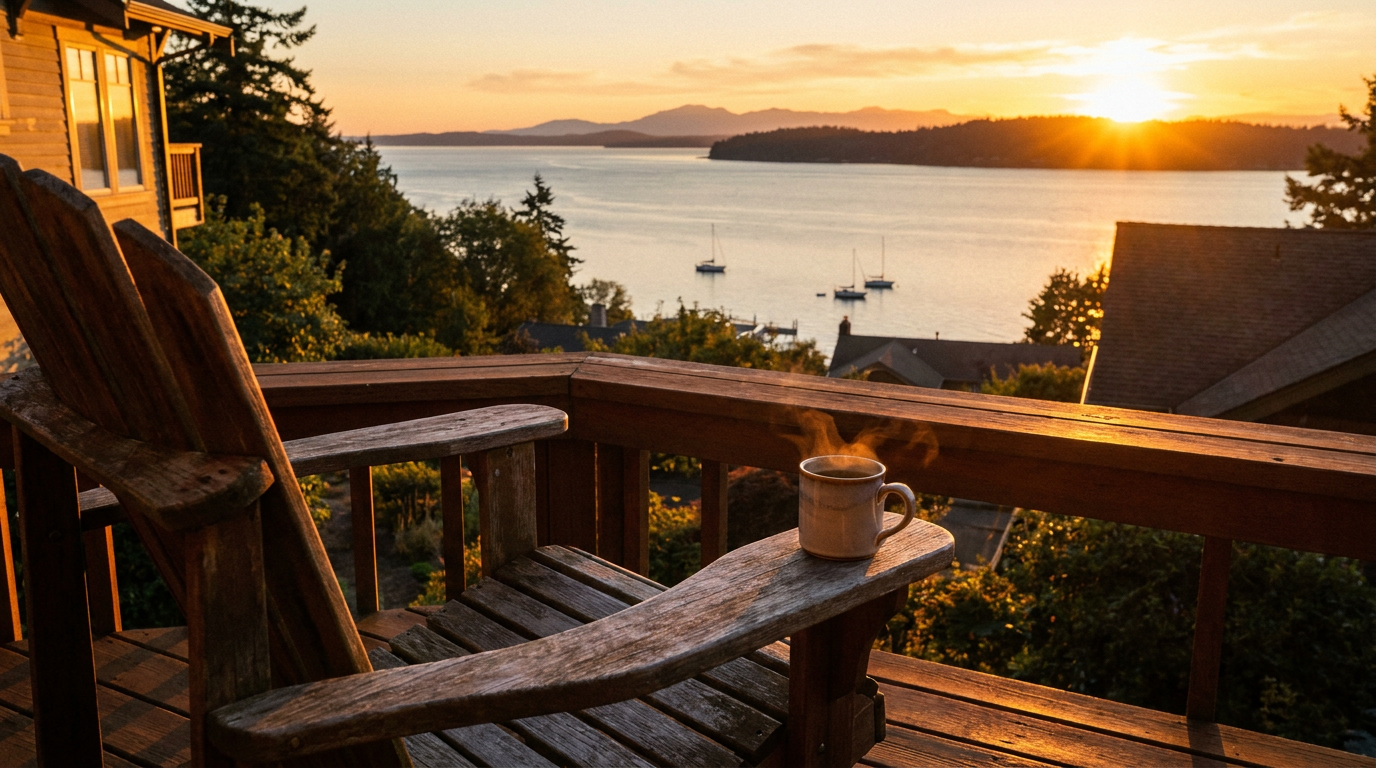
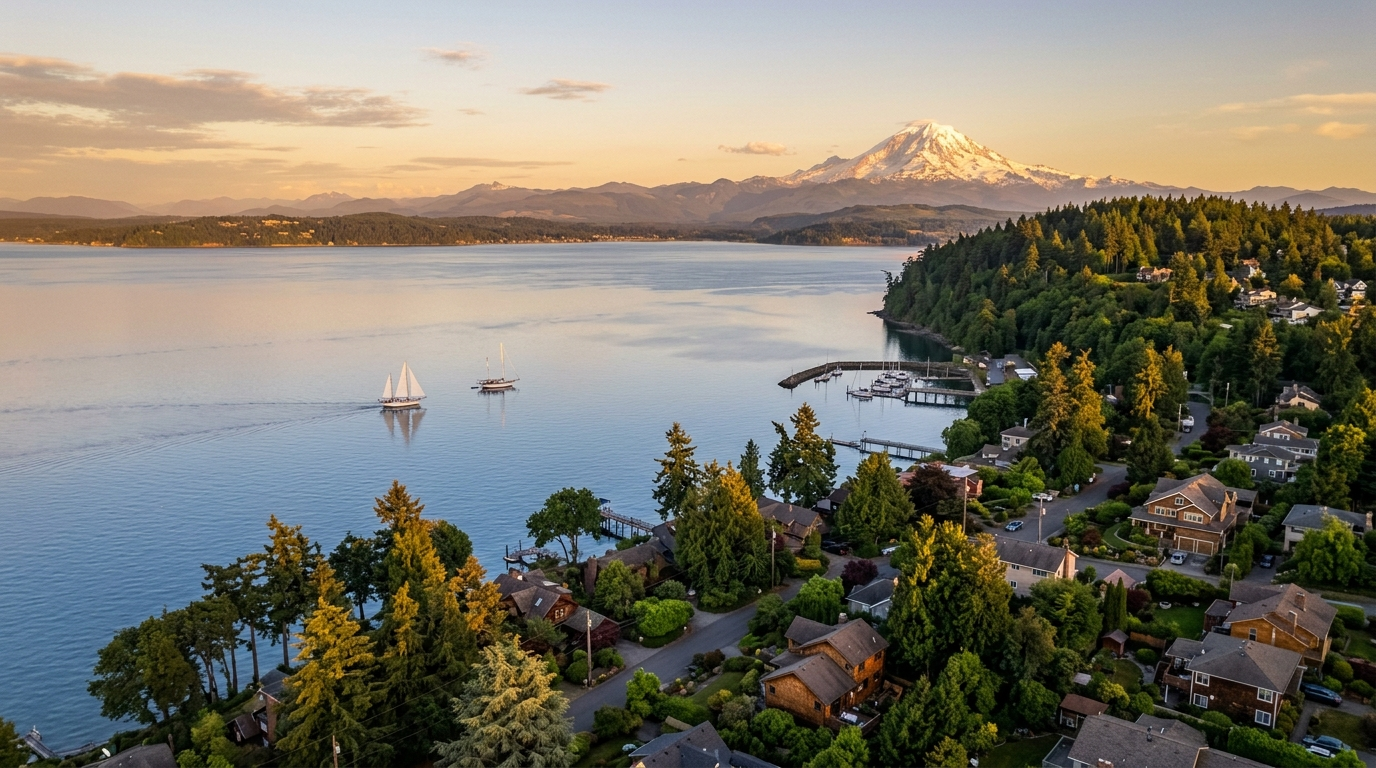
Summers are spectacular. From late June through early October the weather is the best argument anyone has ever made for Pacific Northwest living. Daily highs in the low 70s. Sunlight until almost 10pm in June. Bay breezes. No fire smoke (the Cascade range mostly shields us — we get a few smoky days some Augusts, but nothing like California’s last five summers). No water restrictions. No drought conversations. The bay is swimmable, the mountains are accessible, the bike trails are dry. People genuinely cry when they describe their first Bellingham summer.
Winters are real but mild. Average winter lows in the low 30s. Snow falls maybe two or three times a year and rarely sticks more than 48 hours at sea level. Mt. Baker, 30 miles away, holds the world record for most snow in a single season and is open for skiing November through May. So winter here means: a coat, occasional boots, very rarely a snow shovel.
The gray, however, is the real climate fact you need to internalize. Bellingham averages around 2,000 hours of sunshine a year. San Francisco gets 3,060. Los Angeles gets 3,250. Phoenix gets 3,870. Roughly: we get half the annual sunshine of LA. November through February, you’ll see weeks of overcast at a time. The temperature is mild — usually 38 to 50 — but the sky stays gray, the days are short, and the rain is steady-soft rather than dramatic.
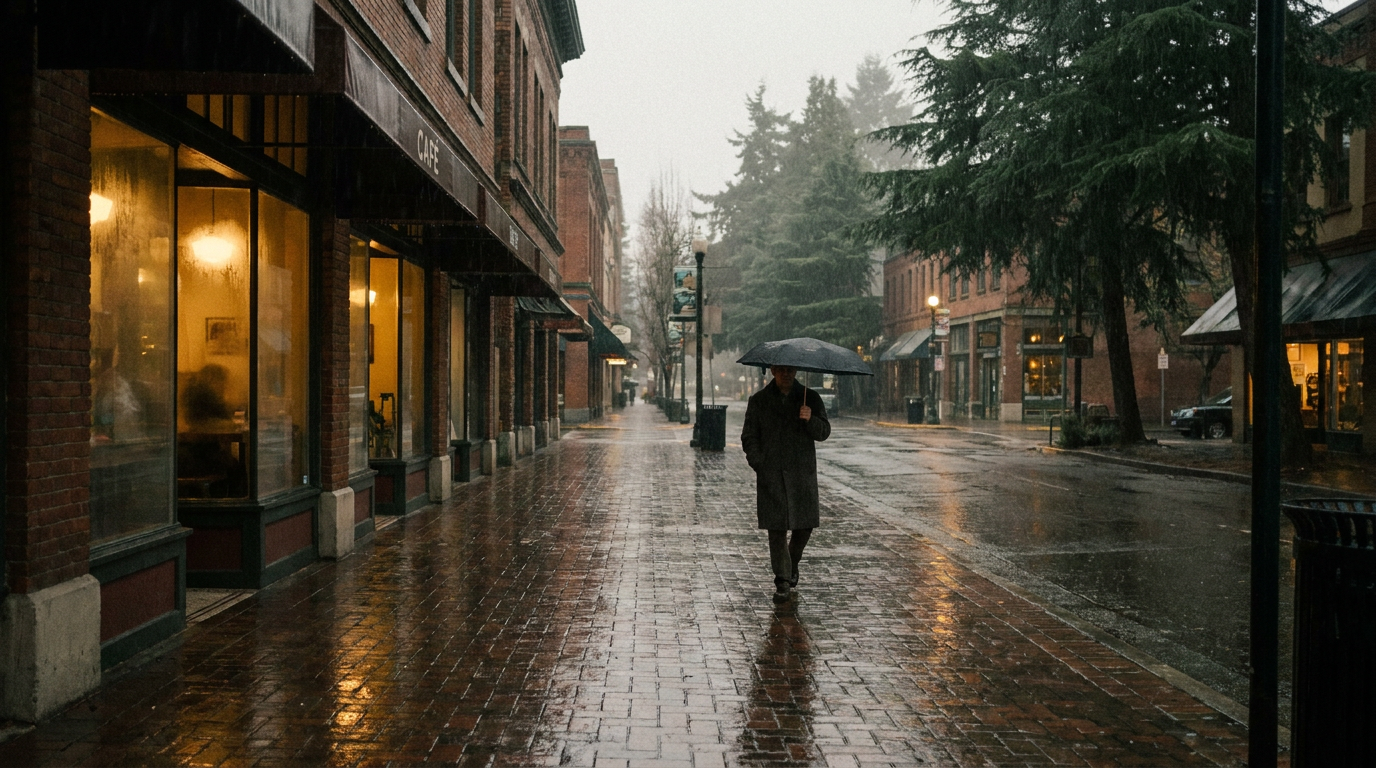
This is the make-or-break for transplants. Some people love it — find it cozy, atmospheric, calming, productive. Others struggle, especially in years two and three after the novelty of summer fades. If you’ve ever experienced seasonal affective symptoms, take it seriously. A daylight lamp, vitamin D, and a winter trip to somewhere sunny in February are standard tools up here. We’re not pretending it’s California. We’re trading 250 days of bright glare for a softer, quieter year-round palette — and a city in motion when summer breaks.
Commute reality — can you still work?
Three working patterns make sense up here. The fourth doesn’t.
1. Fully remote. The cleanest fit. Your zip code becomes a feature. Fast residential fiber is widely available (Ziply, Comcast, and increasingly direct fiber). Time zones align with most US East coast colleagues. Cost of office space (or no office) is irrelevant.
2. Hybrid commuting to Seattle, one or two days a week. Bellingham to downtown Seattle is 90 minutes on a clear Tuesday, 2:15 on a bad one. Amtrak Cascades runs four times a day, leaves from downtown Bellingham, gets you to King Street in 2:25 without a steering wheel. A handful of buyers I work with do the train twice a week. It’s a real lifestyle but you have to be honest that it’s a long day.
3. Tied to the local economy. Healthcare (PeaceHealth St. Joseph is the largest employer), Western Washington University, BP Cherry Point and Phillips 66 refineries, Lummi Nation enterprises, the marine trades, county and city government. A real economy with real jobs — not just remote workers.
4. Daily commute to downtown Seattle. Do not do this. It’s a 2-hour-each-way drive when traffic cooperates. People try it, regret it, and either go back to California or change jobs within 18 months. If your employer requires five days a week in downtown Seattle, you live in Edmonds or Lynnwood, not Bellingham.
For flights: Bellingham International Airport (BLI) flies Alaska to SEA, PHX, Las Vegas, San Diego, and a few seasonal routes. Most California-bound trips go SEA — a 90-minute drive south. Many transplants budget a flight south every February or March; the round trip from BLI to SFO via SEA runs about $250–$350 if booked ahead.
Schools — the comparison families ask about
If you’re coming from a top-tier California public school district — Palo Alto, Cupertino, San Marino, La Cañada, Pleasanton — Bellingham public schools will feel different. They’re solid, well-resourced compared to most of the country, and have several strong programs (Bellingham High’s IB, Squalicum’s robotics, Sehome’s music). But they’re not Gunn or Lynbrook. Class sizes are smaller, college-prep intensity is lower, and the academic culture is calmer.
Many California families find that’s a feature, not a bug. Their kids land at WWU or Western-adjacent state schools — University of Washington, Western Washington, Whitman, Pacific Lutheran — and do beautifully. A few families who want a more academically aggressive environment look at Lynden School District (the county’s highest-rated, with strong private alternatives at Lynden Christian) or Bellingham Christian School. Boarding-school families are rare up here; if elite university prep is the priority, factor that into your equation.
For the K-5 set, the schools are uniformly good. The hard conversations happen in middle and high school for families coming from the most competitive California districts.
The lifestyle shift — what changes
The honest summary: you trade speed for space. Bellingham operates at roughly 70% the tempo of the Bay Area and maybe 60% the tempo of LA. People take meetings standing up at coffee shops, not in Zoom rooms. The 7am gym crowd is real. The 7pm dinner reservation closes at 9. Stores close on Sunday more than you’d expect. The traffic — even at peak — is gentle. The grocery line at Haggen on a Saturday at noon has eight people in it instead of forty.
What people from California consistently miss in their first year: variety of restaurants (Bellingham has 200 good ones, not 2,000), late-night options, Vietnamese pho at 1am, In-N-Out, certain cultural events that just don’t reach this market, and the casual diversity of a major California city. Some of that you can solve with Vancouver BC weekends (45 minutes north). Some you’ll miss.
What people consistently gain: time. The hour and twenty minutes a day you used to spend in commute reappears. The five hours a week you used to spend at errands collapses to two. The constant low-grade financial pressure of California — the math anxiety of mortgage plus tax plus everything — releases. Most transplants describe their nervous system genuinely calming down within four to six months.

Buying a home here without flying up six times
About 40% of my buyers come from out of state, and roughly half of those never visit before they make an offer. The process I run for them is built around that.
- Discovery call. 45 minutes on Zoom. We walk through what matters: view vs. acreage vs. walkability, budget, timeline, school priorities, work pattern. By the end I know which 3–5 neighborhoods to focus on.
- Saved search. You start getting daily emails of new listings matching your criteria. We refine weekly.
- FaceTime walkthroughs. Anytime a listing looks promising, I’m there in 24 hours, on camera, walking you through every room. We do these on FaceTime, Zoom, or Google Meet — whatever’s easiest. Most last 20–30 minutes; you can ask questions live.
- Drone perimeter video. For homes with view or acreage, I’m an FAA-licensed drone pilot and shoot an aerial overview so you can see the full lot from the air.
- Neighborhood orientation video. Once we’re zeroed in on a neighborhood, I shoot a 5-minute walk-through of the surrounding blocks so you understand the texture: who’s mowing the lawn, what the kids are doing, what the streets feel like.
- Visit (optional). If you want to fly up before writing an offer, I’ll plan a Friday-to-Sunday with 8 properly-vetted showings, plus an hour at PeaceHealth, an hour driving the school routes, and a coffee meeting with a local mortgage and title pro. It’s an exhausting weekend but you leave knowing.
- Offer + close. Everything from offer to close runs by email and DocuSign. WA state allows fully remote closings. You can buy a house here without ever boarding a plane.
Five Bellingham neighborhoods California buyers tend to land in
Edgemoor for the Bay-equivalent buyer — luxury bluff homes overlooking Bellingham Bay, the highest median price in the county, the closest emotional analog to a Peninsula or West Hills lifestyle. → Edgemoor neighborhood guide
Fairhaven for the walkable-life buyer — historic Victorian district with the best café-and-bookstore scene in the city, condos and small homes within walking distance of everything, the closest analog to a Berkeley or Pasadena Old Town lifestyle. → Fairhaven neighborhood guide
South Hill for the view buyer on a slightly lower budget — older homes with bay views from the upper streets, more architectural variety than Edgemoor, walkable to Fairhaven.
Sehome for the WWU-adjacent / families with school-age kids — quieter hillside neighborhood walkable to campus and trail systems, mid-century homes on real lots. → Sehome neighborhood guide
Lookout Mountain / Sudden Valley for the acreage-and-view buyer — homes on 1 to 5 acres with Mt. Baker or Lake Whatcom views, 15 minutes to downtown, a more rural feel without the long commute. The most common landing spot for buyers coming from Marin or Sonoma.
Frequently asked
Will I pay California taxes on the sale of my California home if I’m moving to Washington?
Yes — California taxes capital gains on California-sited real estate regardless of where you move. Plan the move with a CPA who handles dual-state transitions. There are timing strategies (move first, sell second; or sell first, then move with capital gains classified appropriately) and primary-residence exclusions that matter. Don’t wing this.
When do I become a Washington resident for tax purposes?
Generally when you establish domicile here — physical presence plus intent to stay. Practical markers: driver’s license switch, voter registration, lease or homeowner’s insurance in your name, primary doctor here. Most CPAs recommend nailing several of those within 30 days of moving and keeping records.
Do I need flood insurance up here?
Most Bellingham city homes — no. Specific waterfront and Nooksack River-adjacent properties — yes, and the maps have been updated post-2021 floods. I check FEMA flood zone status on every offer.
What about earthquakes?
The Cascadia Subduction Zone is real. Big quake risk exists; most homes built since 1990 are engineered to current seismic code. The conversation up here is similar to the California one but earthquake insurance uptake is lower and the typical event return period is longer.
Can I bring my car? My contractor’s truck?
Yes. Washington vehicle registration is straightforward; first-year registration includes a Washington-specific weight fee. You’ll pay state-of-residence sales tax credit (none in WA) so the math works out. Bring the truck.
Healthcare?
PeaceHealth St. Joseph Medical Center is the major hospital — Level III trauma, full specialty mix, generally well-rated. Most Bay Area buyers find healthcare access better here than in their California neighborhood (shorter waits, easier specialist referrals). Mental health resources are thinner; budget for telehealth if that matters to you.
Thinking about Bellingham?
Send me the basics — where in California you’re coming from, what your housing budget looks like, work pattern, anything specific (school priorities, view requirement, walkable life, acreage). I’ll send back two or three neighborhoods to focus on, plus active listings worth a look. The first conversation is 45 minutes on Zoom and answers more questions than two days of internet research.