

Bellingham · The terminus that never came
The Railroad Boom and the Birth of Fairhaven
For a few wild years, four little towns on one bay believed a transcontinental railroad would make them the next great city of the Pacific. The race built Fairhaven almost overnight — and then nearly erased it. Here is how the gamble played out, and how the rivals finally became one Bellingham.
The first boom, and the first bust
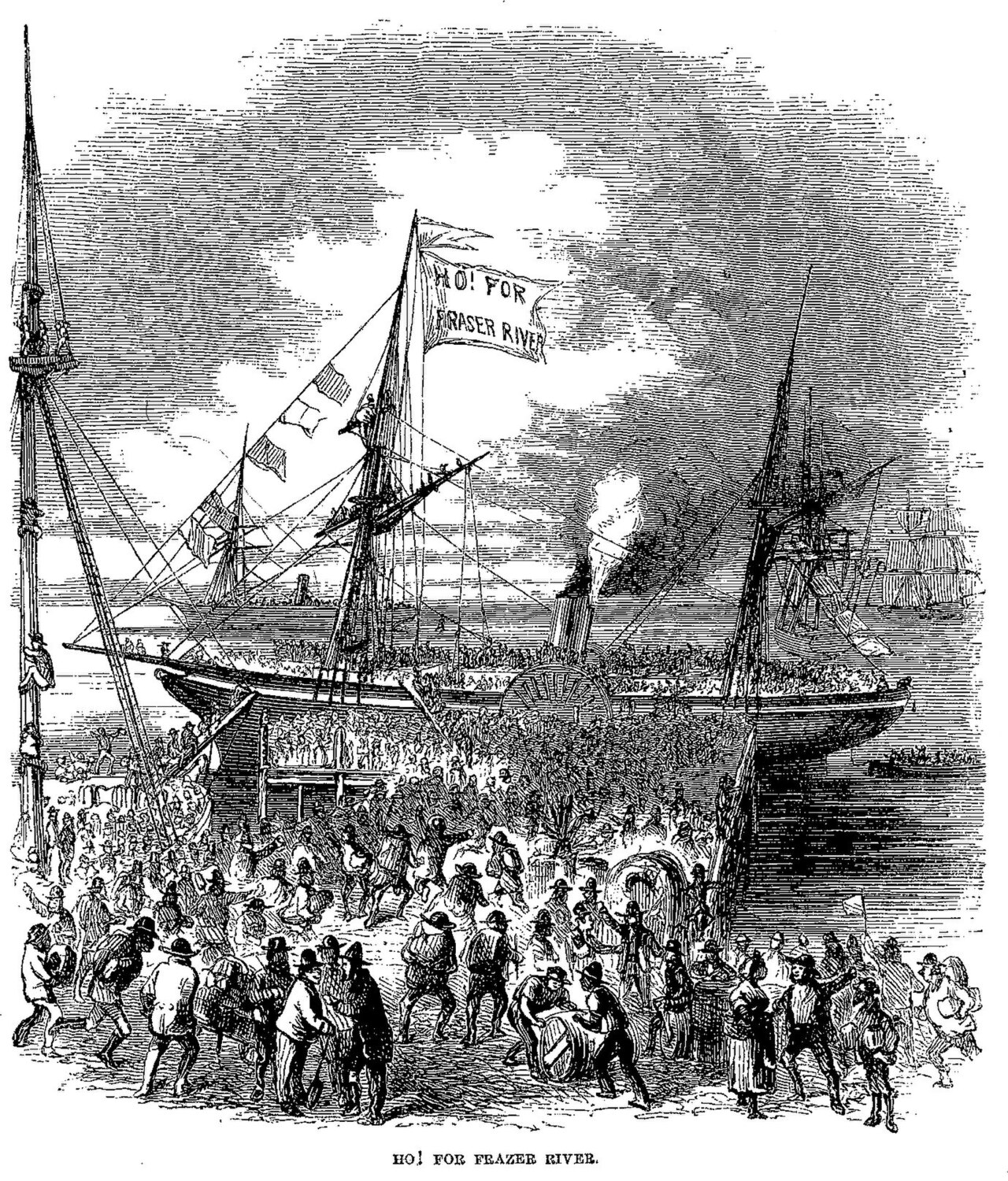
Long before the railroad fever, Bellingham Bay had already learned how fast a fortune can arrive and vanish. In 1858, gold was found on the Fraser River in British Columbia, and the little settlement of Whatcom swelled almost overnight into a tent city. The population leapt from a few hundred to something like ten thousand hopeful prospectors, who pitched tents along the beach and dug for clams when their supplies ran out.
It ended just as quickly. James Douglas, the colonial governor at Victoria, ruled that miners had to buy their licenses and outfit on the British side, at Victoria — not at the American boomtown on the bay. By the fall of 1858 the miners had folded their tents and sailed north by the thousands, leaving Whatcom merchants holding shelves of unsold goods. The first great rush was over before the year was out. The bay would remember the lesson, and then ignore it.
Dirty Dan and the town he drew on paper
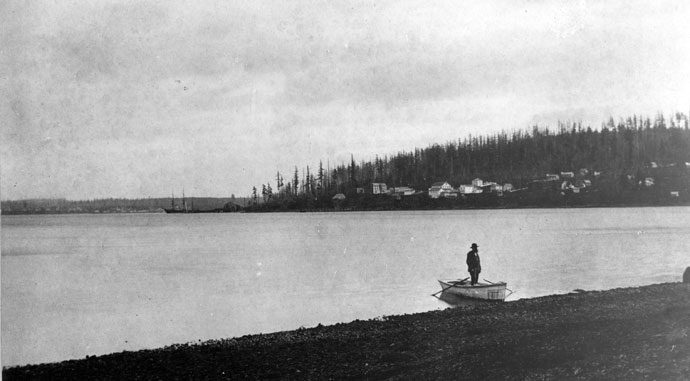
The man who gave Fairhaven its name was an unlikely founder. Daniel “Dirty Dan” Harris was born on New York’s Long Island, went to sea on a whaler as a teenager, jumped ship in Honolulu, and made his way to Bellingham Bay by way of Victoria around 1853. He earned his nickname honestly: shabby, gregarious, a tireless storyteller, and in his early years a cheerful smuggler who rowed cargoes of salmon and liquor across the strait under cover of night.
He was also shrewd. Harris bought out an earlier settler’s 146-acre claim at the mouth of Padden Creek and slowly became the major landowner on the south shore. On January 2, 1883, he filed the plat for a brand-new town he called Fairhaven — 85 blocks, with the main drag, naturally, named Harris Avenue. Lots sold fast, in gold only, and the disheveled old smuggler grossed more than twenty thousand dollars his first year. By around 1888 he sold off most of what remained — roughly 70,000 to 75,000 dollars — to the men who would chase a much bigger dream, and retired to Los Angeles. Today a bronze likeness of him sits on a bench at the Fairhaven Village Green, a little more dignified than the original.
The gamble on the Great Northern
What turned a quiet plat into a frenzy was a rumor — that James J. Hill, the “Empire Builder,” was eyeing Fairhaven as the western terminus of his transcontinental Great Northern Railway. On the Pacific coast in the 1880s, a railroad terminus meant everything: it was the difference between a village and a metropolis. Promoter Nelson Bennett, who had bored the Cascade Tunnel for the Northern Pacific, arrived to make Fairhaven that metropolis.
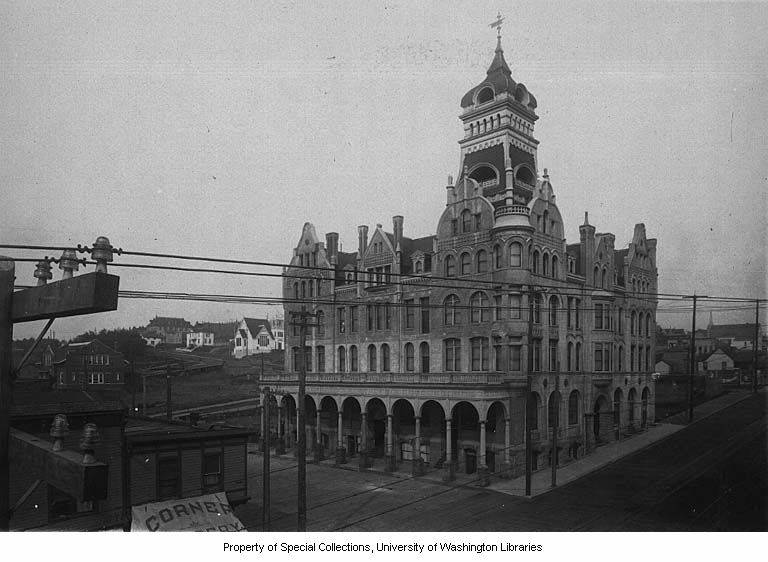
In 1888 Bennett and Charles X. Larrabee joined others to form the Fairhaven Land Company, buying out Dirty Dan’s holdings and platting block after block. Speculators poured in. In the span of roughly two years the town’s population exploded from a few hundred to somewhere between eight and nine thousand. Bennett raised the great Fairhaven Hotel, an ornate five-story landmark that opened in 1890, and sold it to Larrabee — who, a teetotaler, famously closed its bar before Mark Twain came to stay in 1895. Land changed hands at dizzying prices. Everyone, it seemed, was about to be rich.
Four towns, one bay, one prize
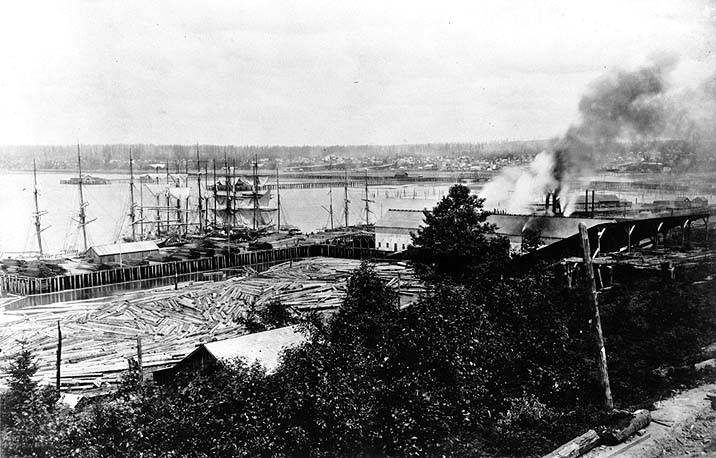
Fairhaven was not alone in its ambition. Four separate towns had grown up along the shore: Whatcom, the oldest, settled in 1852 around Henry Roeder’s mill on Whatcom Creek; Bellingham, a tiny village platted in 1853 that hardly grew at all; Sehome, founded in 1854 over a coal mine on what is now downtown; and Harris’s Fairhaven to the south. For decades they eyed one another as rivals more than neighbors, each convinced it would be the one the railroad chose.
The pressure of the boom finally forced some of them together. In the spring of 1890 Sehome reincorporated, absorbing the little settlement of Bellingham, and soon joined with Whatcom; by early 1891 the two northern towns had consolidated into a single city called New Whatcom. That left two contenders on the bay — New Whatcom and Fairhaven — still racing for the same prize.
Seattle wins, and the bottom falls out
Then, in 1891, the dream collapsed. The Great Northern chose Seattle as its terminus. Fairhaven would be connected to the outside world — Bennett and Larrabee’s Fairhaven and Southern Railway tied the bay into the wider network — but it would never be the grand terminus the speculators had bet their fortunes on.
The Panic of 1893, a nationwide financial collapse, finished the job. Money dried up, banks failed, and the building stopped mid-stride. Fairhaven’s population, which had climbed toward nine thousand, fell to roughly three thousand. Lots that had sold in a frenzy now went begging. The boom that had built a city of brick in a few short years was over, and the bay’s towns were left to make their peace with being ordinary.
Hail, Bellingham
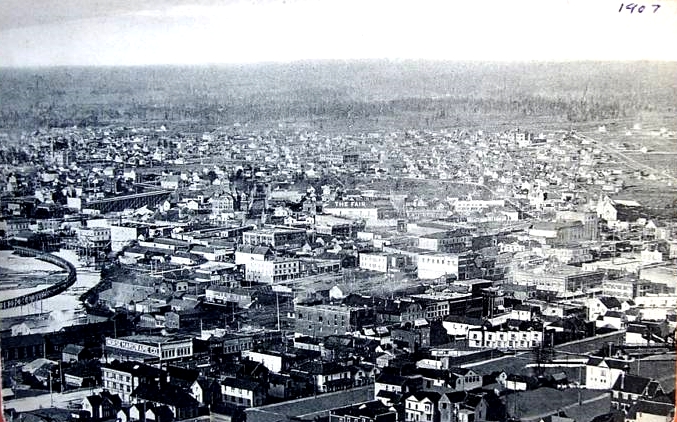
With the railroad gone and the rivalries spent, the logic of going it alone faded. By 1903 New Whatcom (renamed simply Whatcom in 1901) and Fairhaven had grown until they touched, sharing streets and interests. In September, petitions to consolidate circulated in both towns, and on October 27, 1903, the voters said yes — Whatcom by 1,583 to 252, Fairhaven by 580 to 344. To sidestep the old jealousies, they chose a neutral name borrowed from the smallest of the four original villages: Bellingham.
It became official just before midnight on December 28, 1903. As the bell atop City Hall tolled, Whatcom’s outgoing mayor declared, “Farewell, Whatcom and Fairhaven. Hail, Bellingham, all hail!” A census taken four weeks later counted 22,632 residents. The four towns on the bay were, at last, one city.
Fairhaven today
The terminus never came — and that, in a way, is why Fairhaven is what it is. The handsome brick-and-mortar buildings thrown up in the boom were never bulldozed for a railyard, and many still stand. In 1977 the heart of the neighborhood was listed on the National Register of Historic Places as the Fairhaven Historic District, its restored Victorian storefronts now home to cafes, boutiques, and the beloved Village Books. Behind the bookstore, the Fairhaven Village Green hosts summer movies and festivals where a boomtown once dreamed of being Seattle.
For anyone considering a home here, that history is the draw. Fairhaven offers walkable, water-edge living with genuine character — a district that wears its rise-and-fall story on every brick cornice, just a short walk from the bay, the trails, and the ferry north to Alaska.
At a glance
Common questions
Why was Fairhaven built so quickly?
Speculators believed railroad magnate James J. Hill would make Fairhaven the Pacific terminus of his Great Northern Railway. Between 1888 and 1890 that gamble drew a flood of money and people, and the town’s population jumped from a few hundred to roughly eight or nine thousand in about two years.
Who was Dirty Dan Harris?
Daniel “Dirty Dan” Harris was a Long Island-born sailor and former smuggler who became the south shore’s main landowner. He platted the town of Fairhaven on January 2, 1883, then sold most of his holdings around 1888 and moved to Los Angeles. A statue of him sits at the Fairhaven Village Green today.
Why didn’t Fairhaven become the railroad terminus?
In 1891 the Great Northern chose Seattle instead. Fairhaven was still connected to the rail network through the Fairhaven and Southern Railway, but it never became the grand terminus its promoters had envisioned, and the nationwide Panic of 1893 ended the boom for good.
How did the four towns become Bellingham?
Whatcom, Sehome, Bellingham, and Fairhaven grew up as rivals on one bay. Sehome and Whatcom consolidated as New Whatcom by 1891. In 1903, Whatcom and Fairhaven voted to merge under a neutral name borrowed from the smallest original village, and the city of Bellingham became official on December 28, 1903.
What is Fairhaven like now?
Because the railroad never came, the boom-era brick buildings survived. Fairhaven is now a National Register historic district full of restored Victorian storefronts, shops, restaurants, Village Books, and the Fairhaven Village Green — a walkable, water-edge neighborhood prized by home buyers for its character.
Sources: HistoryLink.org (essays on Bellingham, Fairhaven, Daniel “Dirty Dan” Harris, the 1903 Whatcom–Fairhaven consolidation, and the 1858 Fraser River gold rush exodus); City of Bellingham; Western Washington University Heritage Resources; Fairhaven History (fairhavenhistory.com). The Lummi Nation and Nooksack Tribe are the original peoples of this land.
Back to the Bellingham timelineImage credits
- University of Washington Libraries, Special Collections, Public domain. source
- Harper’s New Monthly Magazine, 1860, Public domain. source
- Daniel J. Harris in his rowboat, 1884, Public domain. source
- Photo by Eric A. Hegg; University of Washington Libraries, Public domain. source
- Bird’s-eye view of Bellingham, 1907 postcard, Public domain. source